
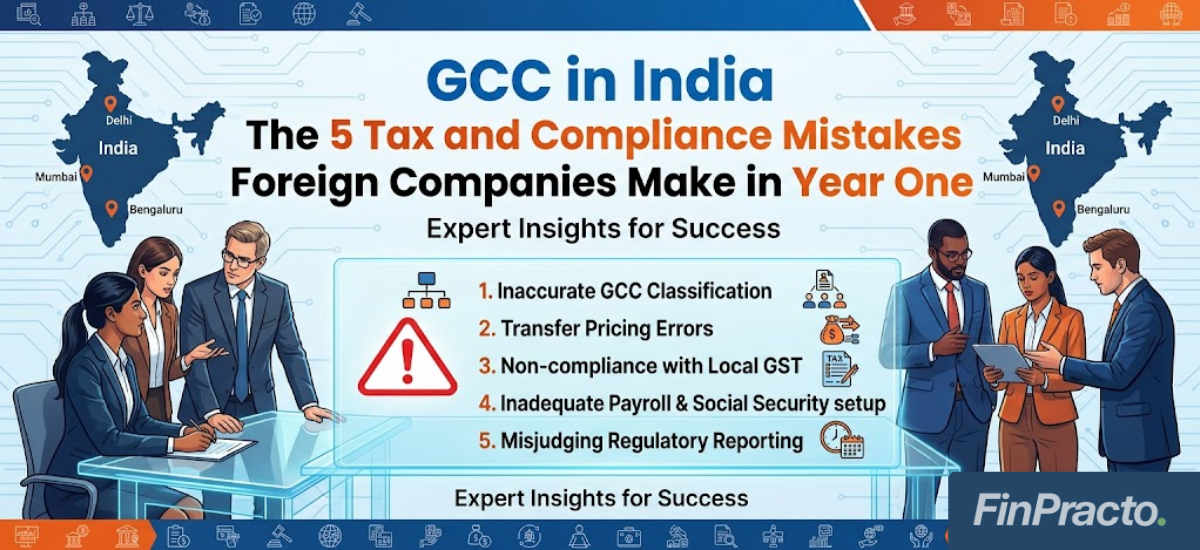
India’s tax and regulatory environment is genuinely complex and the intersection of five different legal regimes – Income Tax, GST, FEMA, Transfer Pricing and Labour Law – creates compliance traps that are simply invisible until you are inside them.
This guide is about what goes wrong in Year One of operations – once the entity is incorporated, the bank account is open, employees are joining and money is beginning to flow between the Indian entity and the parent company. That is when the exposure begins.
Mistake 1: Triggering Permanent Establishment Without Realising It
Of all the mistakes on this list, this one has the most severe financial consequence and the least amount of early warning.
What Is Permanent Establishment (PE)?
Under Indian domestic law and under most Double Taxation Avoidance Agreements (DTAAs), a foreign company that creates a Permanent Establishment in India becomes taxable in India on income attributable to that PE – at the standard foreign company tax rate of 40% (plus surcharge and cess, effective rate approximately 43.68%).
Most foreign companies setting up GCCs understand this in principle. What they do not appreciate is how easily a PE is triggered during Year One.
The Specific Triggers That Catch GCC Companies Out
Fixed Place PE: The Indian entity’s office is a PE of the parent by definition – but the question is whether it is a service PE (remunerated at arm’s length, no further exposure) or a trading/sales PE (potentially attributing parent company profits to India). The characterisation depends entirely on how the intercompany agreement is drafted and what the Indian employees actually do.
Agency PE: If senior Indian employees – particularly those with “Business Head,” “Country Manager,” or “VP” titles – are concluding contracts or habitually exercising authority to bind the parent, an Agency PE is created. A 2024 ITAT ruling (Ford India vs DCIT, ITA No. 812/Mds/2022) reinforced that even informal authority – demonstrated through email correspondence – can constitute an Agency PE.
Service PE: Under many DTAAs (India-USA, India-UK, India-Singapore), if employees or seconded staff of the parent are present in India for more than 183 days in a 12-month period providing services, a Service PE is triggered. Year One is particularly risky because senior foreign nationals often spend extended time in India during the setup phase without tracking days.
The 2026 Dimension
The India-Brazil DTAA was amended effective 18 October 2025, incorporating a Principal Purpose Test (PPT) and an expanded scope of Permanent Establishment. This signals a clear CBDT direction: treaty PE provisions are being tightened, not relaxed. Companies operating under older intercompany structures should review PE risk afresh.
What to do instead: Draft the intercompany agreement to clearly characterise the Indian entity as a captive service provider operating on a cost-plus basis. Restrict Indian employee authority to exclude contract conclusion with third parties. Track foreign national presence in India from Day One and critically obtain a legal opinion on PE risk before the first foreign employee arrives.
Mistake 2: Getting Withholding Tax on Management Fees and Royalties Wrong
The second most common mistake involves the payments flowing from the Indian GCC to its parent – management fees, brand fees, shared services charges, technology licensing fees and similar charges.
The Domestic Rate Problem
Since Finance Act 2023, the domestic withholding tax rate on Royalty and Fees for Technical Services (FTS) paid to non-residents has been 20% (plus applicable surcharge and cess – effective rate approximately 21.84%). This represents a doubling from the previous rate of 10% and is now higher than the rate prescribed in most of India’s DTAAs.
This creates a critical two-step obligation that most GCC finance teams miss in Year One:
Step 1: Determine whether the payment is Royalty, FTS, or neither under both domestic law and the applicable DTAA. These definitions do not always align. Under many DTAAs, FTS is only taxable if it involves “making available” technology – meaning the Indian entity gains independent capability it can use without further assistance from the parent. Routine management oversight, shared service charges and group HR support typically do not meet this threshold.
Step 2: If the DTAA rate is lower (typically 10-15%), the Indian entity can deduct at the treaty rate instead of 20% but only with strict documentary compliance.
The Form 10F/ Form 41 Trap
To claim DTAA benefits, the non-resident parent must furnish a valid Tax Residency Certificate (TRC) and file Form 10F electronically on the Indian income tax portal. Failure to submit Form 10F on time results in higher domestic withholding, denial of treaty benefits, delayed refunds and increased scrutiny during assessments.
What catches GCCs in Year One: the parent has never interacted with the Indian tax portal before. Setting up PAN registration for the foreign entity and submitting Form 10F electronically takes time. The first payment to the parent often goes out before this is in place and the Indian entity ends up deducting TDS at 20% instead of 10%, overpaying by ₹10 for every ₹100 remitted.
The “Make Available” Defence
Under DTAAs with the USA, UK, Singapore, UAE and several other major GCC home jurisdictions, FTS is taxable in India only if the services “make available” technical knowledge. Judicial interpretation has consistently distinguished between a mere provision of service and the imparting of technology. Routine maintenance, consultancy or oversight where no underlying technical knowledge is transferred has frequently been held not to qualify as FTS.
This means many management fee and shared service payments that GCCs are deducting TDS on at 20% may not be taxable in India at all or taxable only at 10-15% under the applicable DTAA.
What to do instead: Before the first intercompany payment, obtain a legal opinion on the characterisation of each payment type. Ensure the parent’s TRC and Form 10F are filed on the income tax portal. Draft intercompany service agreements to clearly establish the nature of services and whether they involve “making available” technology or merely providing routine support.
Mistake 3: The GST Export of Services Trap – When Zero-Rated Becomes Fully Taxable
This mistake is specific to GCCs and has generated enormous controversy in India’s tax community – culminating in one of the most high-profile indirect tax disputes in recent years.
The Basic Premise
A GCC in India provides services to its overseas parent. Since the parent is outside India and payment is received in foreign exchange, the Indian entity treats the revenue as an “export of services” – zero-rated under Section 16 of the IGST Act, 2017. No GST is payable and the entity files a Letter of Undertaking (LUT) each year.
This is correct – but only if five specific conditions under Section 2(6) of the IGST Act are all met simultaneously:
- The supplier is in India
- The recipient is outside India
- The place of supply is outside India
- Payment is received in convertible foreign exchange (or permitted INR)
- The supplier and recipient are not merely establishments of distinct persons (i.e., not just branches).
The supplier and recipient are not merely establishments of the same person. The fifth condition is where GCCs fail.
The Budget 2026 Amendment
Budget 2026 proposed the omission of Section 13(8)(b) of the IGST Act – the special rule that deemed the place of supply for “intermediary services” to be the supplier’s location in India. This change means outbound facilitation and backend support performed from India for overseas recipients may now qualify as export of services. However, the same change re-anchors inbound services received from non-residents to the Indian recipient, making them “import of services” taxable under reverse charge.
What to do instead: Review every service category provided by the Indian GCC to the parent – individually, not as a bundle. Determine whether each qualifies as export of services under all five conditions. File a properly structured LUT each year before the first export invoice. Review the Budget 2026 amendment’s impact once the commencement notification is issued.
Mistake 4: Transfer Pricing – The Cost-Plus Trap and the Missing Contemporaneous Study
Transfer pricing is the most audited area of India’s international tax framework. For GCCs specifically, it is also the area where mistakes compound most silently – because the damage only becomes visible two or three years later, when the assessment opens.
The Standard GCC Model and Its TP Vulnerability
Most GCCs operate on a Cost-Plus model – the Indian entity charges its parent the total cost of operations plus a markup. This is clean in principle. In practice, three mistakes make it vulnerable:
Mistake 4a: The markup is set without a benchmarking study. The cost-plus percentage is often set by the parent’s global TP team or based on what “feels right” for the industry – 8%, 10%, 12%. Without a contemporaneous benchmarking study specific to India, this number has no defensible basis. Under IT Rules 2026, contemporaneous documentation must be in place from Day One – it cannot be assembled retrospectively when a notice arrives.
Mistake 4b: The functional profile does not match the pricing. A GCC often starts as a simple captive performing low-risk functions. Over the course of the year, Indian team members organically take on more strategic responsibilities. By Year End, the functional profile has changed but the TP study and intercompany agreement still reflect the original low-risk characterisation. This mismatch is one of the most common triggers for TP adjustments.
Mistake 4c: Management fee is embedded in the cost base without separate TP analysis. Many GCCs receive management services from the parent – group IT infrastructure, HR systems, finance shared services and embed these costs in their cost base without separately analysing whether the charge is arm’s length. The Transfer Pricing Officer will examine each cost category independently.
The Penalty Exposure
Under Chapter 21 of the IT Act 2025, failure to maintain contemporaneous TP documentation attracts a penalty of 2% of the aggregate value of international transactions. For a GCC with ₹150 crore in intercompany transactions, this is a ₹3 crore penalty – before any adjustment on the underlying tax.
Block TP Assessment, introduced under the IT Act 2025, allows the Arm’s Length Price determined for Tax Year 2026-27 to be applied across the following two years for stable, recurring transactions – a significant efficiency gain for GCCs with predictable cost-plus arrangements.
What to do instead: Commission a contemporaneous benchmarking study before the first billing cycle. Ensure the functional analysis accurately reflects what Indian employees actually do – not what the intercompany agreement says they do. Review the TP study annually as the GCC evolves and assess Block TP Assessment eligibility for stable recurring transactions from Tax Year 2026-27.
Mistake 5 FEMA – The ECB Trap and the Annual Return Gap
The Foreign Exchange Management Act, 1999 (FEMA) governs all cross-border money flows involving Indian entities. For GCCs, two FEMA failures are particularly common.
Failure 5a: Treating Parent Company Loans as Simple Intercompany Funding
In the first year of operations, a GCC often needs working capital before it becomes self-sustaining through service billings. The parent advances funds – informally, quickly, documented as an “intercompany loan.” This is an External Commercial Borrowing (ECB) under FEMA and ECBs are not informal.
If a GCC borrows from the parent company, even for legitimate working capital purposes, it must comply with RBI’s ECB framework – including all-in cost ceilings, end-use restrictions and reporting requirements.
The all-in cost ceiling for most corporate ECBs is the applicable benchmark rate (SOFR or T-Bill rate) plus 500 basis points. Paying the parent more than this or not reporting the ECB to RBI within 30 days of drawdown is a FEMA violation.
Consequences of non-compliance include compounding under FEMA (penalties up to three times the sum involved), mandatory regularisation through the RBI’s compounding process and restriction on future remittances.
Failure 5b: Missing the FLA Return
Every Indian company that has received Foreign Direct Investment is required to file an Annual Return on Foreign Liabilities and Assets (FLA Return) with the Reserve Bank of India by 15 July of each year, through the RBI’s FLAIR portal.
In Year One, this deadline is almost always missed because the GCC finance team either does not know it exists, or assumes it applies from Year Two onwards. It applies from the first year.
Key figure: Missing the FLA Return attracts a penalty of ₹10,000 per day of continuing default. More significantly, it creates a compliance gap that surfaces during subsequent RBI inspections and can delay dividend repatriation approvals.
What to do instead: Any funding from the parent beyond equity infusion must be structured as a proper ECB – with RBI reporting, correct interest rate documentation and end-use compliance. Build the FLA Return (15 July) into the compliance calendar from incorporation.
How FinPracto Supports GCCs Through Year One and Beyond
At FinPracto, we work with foreign companies entering India at every stage – from pre-incorporation planning through Year One operations and ongoing compliance. Our GCC support includes:
- PE Risk Assessment – Functional analysis and intercompany agreement review to minimise PE exposure before operations begin
- Withholding Tax Advisory – Payment-by-payment WHT analysis, Form 10F and TRC management, DTAA benefit structuring
- GST Export Compliance – LUT filing, service characterisation review, cross-border GST position advisory and CBIC circular analysis
- Transfer Pricing – Contemporaneous Local File preparation, benchmarking studies, functional analysis and Form 48 filing under IT Rules 2026
- RBI & FEMA Compliance – ECB structuring and RBI reporting, FLA Return filing, FEMA annual compliance calendar management
- Expat Tax and Shadow Payroll – Advisory for foreign nationals on deputation to India, including PE-safe employment structuring.