
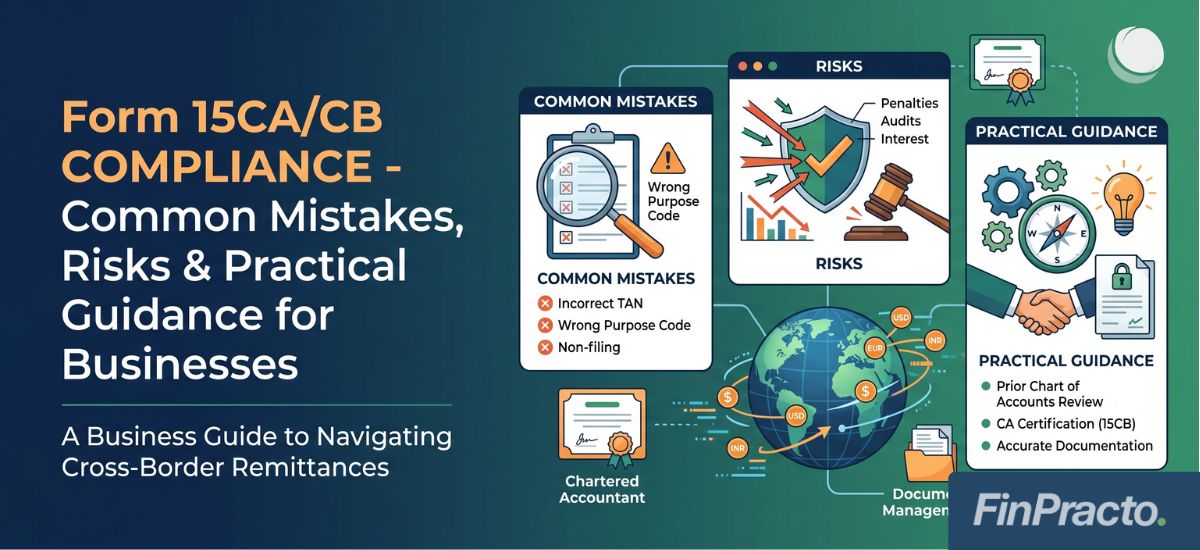
With the increasing integration of Indian businesses into the global economy, cross-border remittances have become a routine yet critical function. Payments towards software services, technical consultancy, royalties and overseas vendors are often time-sensitive and operationally significant.
However, such transactions are governed by a stringent compliance framework, where Forms 15CA (Form 145 as per the Income Tax Act,2025) and 15CB (Form 146 as per the Income Tax Act,2025) act as key regulatory checkpoints. These forms ensure that the taxability of foreign remittances is correctly evaluated and appropriate taxes are withheld before funds are remitted outside India.
In practice, most compliance failures do not arise from lack of intent but from interpretational gaps, fragmented processes and execution-level errors. The consequences, however, can be immediate -ranging from bank-level remittance blocks to financial penalties and increased regulatory scrutiny.
Regulatory Framework and Practical Relevance
1. Form 15CA/Form 145 – Remitter’s Declaration
Form 15CA/Form 145 is a declaration submitted by the remitter capturing key details such as the nature of payment, amount, and its taxability. It serves as a primary reporting tool for both tax authorities and Authorized Dealer (AD) banks.
2. Form 15CB/Form 146 – Chartered Accountant’s Certification
Form 15CB/Form 146 is issued by a Chartered Accountant after examining the transaction in detail. It certifies whether the payment is chargeable to tax, determines the applicable TDS rate, and ensures compliance with provisions and relevant DTAA.
3. Interdependence of Forms
Where Form 15CB is applicable, Form 15CA (Part C) must be consistent with the certificate in all respects. Any mismatch can result in validation errors, rejection or delays in processing the remittance.
Key Areas Where Businesses Commonly Make Errors
1. Errors in Determining Taxability and Selecting the Correct Form
A significant portion of errors originates at the stage of evaluating whether a remittance is chargeable to tax and selecting the appropriate Part of Form 15CA. Businesses often rely on a superficial interpretation of thresholds, assuming that transactions below ₹5 lakh fall under Part A or that non-taxable outcomes eliminate compliance requirements.
The requirement to file depends on whether the income is chargeable to tax, not merely on the final tax payable. Further, the ₹5 lakh threshold applies on an aggregate basis during the financial year, which is often not tracked systematically. These gaps lead to incorrect classification, resulting in rejection or delays at the bank level.
2. Inadequate Application of DTAA and Supporting Documentation
While businesses are increasingly aware of DTAA benefits, practical implementation often falls short. The absence of key documents such as a valid Tax Residency Certificate (TRC), Form 10F or a Permanent Establishment (PE) declaration can invalidate the application of treaty benefits.
Additionally, incorrect interpretation of the nature of income – whether it qualifies as royalty, fees for technical services or business income – can lead to incorrect TDS rates. Such errors may not be immediately visible but can create significant exposure during assessments.
3. Data Inconsistencies and Filing-Level Errors
A recurring issue in Form 15CA/CB compliance is the lack of consistency between the two forms. Since Form 15CA (Part C) is based on Form 15CB, any mismatch in remittance amount, nature of payment or payee details can result in system rejection.
Beyond this, procedural errors such as incorrect PAN/TAN, expired Digital Signature Certificates, typographical mistakes or incorrect sequencing of filings are common. While these are operational in nature, they directly impact the ability to complete filings and process remittances on time.
4. Incorrect Classification and Regulatory Misalignment
Errors in identifying the correct nature of payment and corresponding RBI purpose codes can trigger compliance flags at the bank level. With automated validation systems in place, even minor classification errors can lead to delays or additional scrutiny.
5. Overlooking Interlinked Regulatory Implications
Foreign remittance compliance does not operate in isolation. Payments involving import of services may attract GST under the Reverse Charge Mechanism (RCM), which is frequently overlooked when focusing solely on income-tax compliance.
In addition, inadequate supporting documentation – such as incomplete agreements, invoices or tax analysis – can weaken the defensibility of the position adopted in Form 15CB. These gaps become critical during audits or scrutiny, where documentation forms the basis of validation.
6. Absence of Structured Internal Processes
Perhaps the most fundamental issue across organizations is the lack of a structured compliance framework for foreign remittances. In many cases, tax evaluation, documentation collection and remittance execution are handled in silos, leading to fragmented decision-making.
Without proper monitoring systems, businesses fail to track thresholds, maintain updated documentation, or ensure timely compliance. This results in repeated errors and increased reliance on last-minute corrective actions.
Consequences of Non-Compliance
1. Financial and Regulatory Exposure
Non-compliance may lead to penalties, disallowance of expenses and interest on TDS defaults.
2. Operational Disruptions
In practical terms, the more immediate impact is operational. Remittance delays can disrupt supply chains, affect vendor relationships, and lead to contractual inefficiencies.
3. Increased Scrutiny and Compliance Burden
Repeated inconsistencies or errors may attract heightened scrutiny from tax authorities, increasing the long-term compliance burden on the organization.
Practical Approach to Effective Compliance
1. Pre-Transaction Tax Evaluation
Taxability and DTAA applicability should be evaluated at the contract stage rather than at the time of remittance. This ensures clarity and avoids last-minute complications.
2. Documentation and Process Alignment
Maintaining updated documentation and aligning tax, finance, and treasury functions ensures consistency in compliance and execution.
3. Periodic Review and Monitoring
Regular internal reviews of foreign remittance processes help identify gaps and strengthen compliance frameworks over time.
HowFinPracto Supports Businesses?
At FinPracto, Form 15CA/CB (Form 145/146) compliance is approached as part of a holistic cross-border compliance framework. We assist businesses in evaluating taxability, applying DTAA provisions accurately and ensuring end-to-end compliance with income-tax, GST and FEMA regulations.
Our focus extends beyond filings to building robust, process-driven systems that enable seamless execution of international transactions while minimizing regulatory risk.
Conclusion
Form 15CA/CB (Form 145/146) compliance is a critical component of cross-border transaction management. While often perceived as procedural, it has significant implications for financial accuracy, regulatory adherence and operational continuity.
A structured approach – supported by sound interpretation, strong documentation and integrated processes – enables businesses to manage foreign remittances efficiently and with confidence.
In an increasingly globalized business environment, precision in compliance is essential not only for risk mitigation but also for sustaining credibility and growth.