
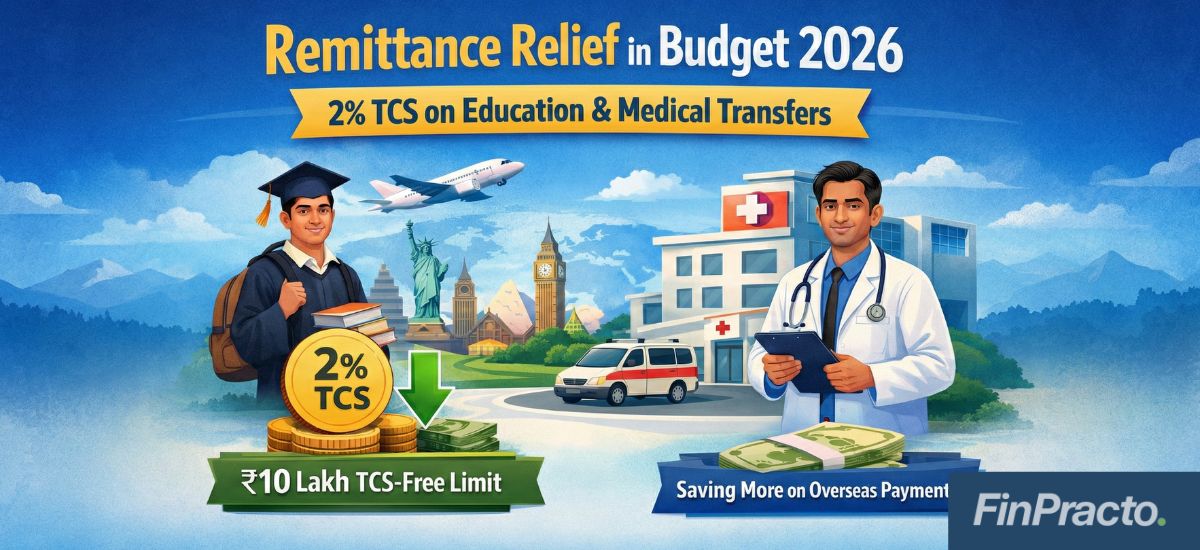
For many Indian families, sending money overseas isn’t a luxury decision. Budget 2026 brings meaningful relief in this space and for once, it directly reduces the upfront cash strain.
Let’s understand what has changed and why it matters.
The Big Shift – TCS Reduced to 2% for Education & Medical Remittances
Tax Collected at Source (TCS) on remittances under the Liberalised Remittance Scheme (LRS) for Education & Medical treatment has been reduced from 5% to 2%.
While TCS is adjustable against your final tax liability, it directly affects cash flow. A 5% collection on large remittances meant significant funds being blocked until refund or set off. Now, the upfront burden reduces substantially.
What This Means in Practical Terms?
If a parent remits ₹20 lakh towards overseas tuition:
- Earlier TCS at 5% = ₹1,00,000 blocked
- Now TCS at 2% = ₹40,000 blocked
That’s ₹60,000 of improved liquidity immediately. For families funding multi-year programs abroad, the cumulative difference is significant.
Higher LRS Threshold: ₹10 Lakh TCS-Free
Another important change – Remittances up to ₹10 lakh per financial year under LRS are now exempt from TCS. This is particularly helpful for:
- Families making moderate remittances
- Students sending initial living expenses
- Individuals paying for overseas certifications or short-term medical care
Earlier, even smaller remittances triggered TCS once thresholds were crossed. Now, the compliance and liquidity pressure reduces for mid-sized transfers.
Why This Relief Is More Than Just a Percentage Cut?
TCS is not an additional tax but it behaves like one in the short term. Families often face:
- High tuition deposits
- Visa-related payments
- Advance accommodation expenses
- Hospital admission deposits
Blocking 5% of the amount added stress during already financially heavy transactions. Reducing TCS to 2% acknowledges that education and healthcare remittances are not discretionary spending – they are essential expenditures.
A Quick Reality Check
Before assuming universal relief, keep these in mind:
- The reduced 2% TCS applies specifically to education and medical remittances.
- Other categories of overseas remittances may continue under different TCS rates.
- PAN compliance remains mandatory for LRS transactions.
- Proper classification of remittance purpose is critical. Misclassification can lead to incorrect TCS application.
Banks will rely on documentation submitted at the time of remittance so clarity matters.
Cash Flow Planning Just Became Easier
For high-value education remittances, especially those funded via education loans, even a 3% reduction in TCS can improve liquidity planning.
Parents often underestimate the impact of TCS on:
- Foreign exchange planning
- Working capital management
- Refund timelines
With the threshold raised to ₹10 lakh TCS-free, smaller remittances may now proceed without any upfront tax collection.
What Should Taxpayers Do Now?
- Review planned overseas payments for FY 2026-27
- Structure remittances efficiently within the ₹10 lakh threshold where possible
- Ensure correct purpose codes while remitting
- Track TCS credits in Form 26AS/AIS for reconciliation
- Coordinate with your bank on documentation requirements
Even though TCS is adjustable, mismatches in reporting can delay credit claims during tax return filing.
The Larger Policy Signal
This move reflects a broader intent encouraging legitimate overseas education and medical spending without penalising liquidity. It balances monitoring of foreign remittances with practical relief for genuine use cases.
Final Takeaway
Budget 2026’s remittance relief may not make headlines like rate cuts do but for families wiring funds abroad, it makes a tangible difference. At FinPracto, we see tax not just as compliance but as financial planning. When regulations shift, the real advantage lies in understanding how to align your decisions early. If you are planning overseas remittances this year, a quick review can ensure you benefit fully from these changes without surprises at filing time.