
You spent years building it.
Every year you contributed the maximum. You enrolled in the High-Deductible Health Plan to stay eligible. You invested the balance in index funds and watched it compound tax-free. By the time you decided to return to India, your HSA had grown to $60,000 – $80,000 – sometimes more and then someone told you it was going to be complicated. They were right.
However, complicated does not mean catastrophic. It means you need to understand exactly what you have, how two different tax systems view it and most importantly – what decisions you need to make before you board your flight home because the window for smart HSA planning closes the moment you become a full tax resident of India.
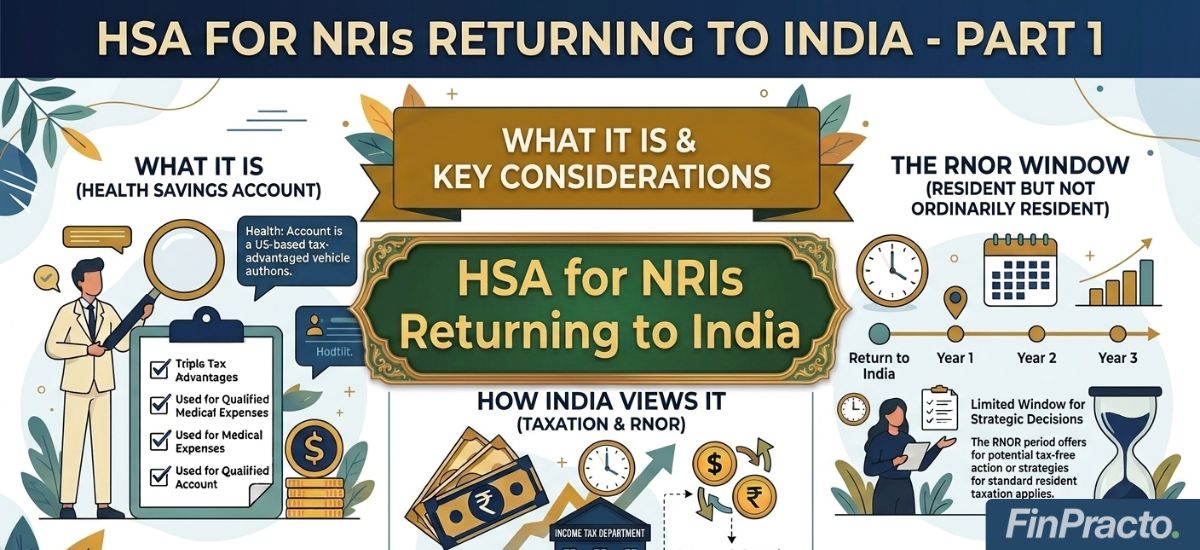
This is Part 1. It covers what an HSA is, why India does not recognise it the way the US does and how to use your RNOR window strategically before the Indian tax clock fully starts.
What is an HSA and Why is it so valuable in the US?
A Health Savings Account is a US government-created, tax-advantaged savings vehicle available to individuals enrolled in a qualifying High-Deductible Health Plan (HDHP). It is one of the most powerful wealth-building tools in the US tax code because of what practitioners call the triple tax advantage:
- Contributions reduce your taxable income – every dollar contributed is deducted from your federal taxable income
- Growth is completely tax-free – interest, dividends and capital gains inside the HSA accumulate with zero US tax
- Qualified withdrawals are tax-free – when used for qualified medical expenses, withdrawals carry no income tax or capital gains tax
2026 HSA Limits and HDHP Requirements
| Parameter | 2026 Amount |
| HSA contribution limit – self-only | $4,400 |
| HSA contribution limit – family | $8,750 |
| Catch-up contribution (age 55+) | Additional $1,000 |
| Minimum HDHP High-Deductible Health Plan (HDHP) deductible – self-only | $1,700 |
| Minimum HDHP deductible – family | $3,400 |
| HDHP out-of-pocket maximum – self-only | $8,500 |
| HDHP out-of-pocket maximum – family | $17,000 |
Key 2026 changes under the One Big Beautiful Bill Act (OBBB):
The OBBB expanded HSA access in ways that directly affect NRIs still in the US or maintaining US health coverage:
- Telehealth and remote care services before meeting the HDHP deductible are now permanently allowed without affecting HSA eligibility – effective from 1 January 2025
- Bronze and catastrophic exchange plans now qualify as HSA-compatible HDHPs from 1 January 2026
- Direct Primary Care Service Arrangements under $150 per month ($300 for family) no longer disqualify HSA eligibility from 1 January 2026
These changes expand contribution eligibility during your final years in the US – maximise your contributions before your HDHP coverage ends.
The Fundamental Problem: India does not recognise HSA Tax Benefits
India does not recognise the HSA structure as a tax-advantaged account. Just as the United States does not recognise India’s PPF or EPF for tax exemption, India likewise does not recognise the US HSA as a tax-advantaged wrapper.
From an Indian tax perspective, an HSA is a foreign investment account – not a tax-exempt healthcare account. Once an individual becomes a full tax resident of India, the Income Tax Department looks through the HSA structure and taxes the underlying income components – interest, dividends and capital gains – based on their nature under Indian tax law.
This creates the fundamental mismatch: what is triple tax-free in the US becomes a taxable foreign asset in India. Managing that mismatch is the entire point of HSA planning for returning NRIs.
The Three Stages – How your Residential Status changes everything
Your HSA’s Indian tax treatment depends entirely on your residential status under Section 6 of the Income Tax Act, 2025. Understanding which stage you are in is the most important first step.
Stage 1: NRI – Living and Working in the US
While you are an NRI – Living in the US and filing US taxes – your HSA has zero Indian tax implications. You do not mention it in your Indian ITR. The income accumulating inside it is not taxable in India. There is nothing to do on the Indian side. All three US tax advantages apply in full. Your obligation during this stage: contribute the maximum, invest the balance and begin planning your return strategy well before your last day of US employment.
Stage 2: RNOR – The Golden Window After Return
RNOR – Resident but Not Ordinarily Resident – is a transitional residential status that most returning NRIs qualify for during their first 2 to 3 years back in India. It is the single most valuable tax planning window available to returning NRIs, and it is the period where your HSA strategy must be executed.
During the RNOR period:
- HSA earnings remain tax-free in India – interest, dividends and capital gains inside the HSA are not taxable
- The HSA does not need to be reported in your Indian ITR under Schedule FA
- Foreign income generally remains outside Indian tax
- US tax rules on the HSA continue to apply exactly as before
If you get NRI or RNOR status in India, earnings in an HSA stay tax-free in India and HSA accounts need not be reported in Indian tax returns.
How long does RNOR last?
It depends on how long you were abroad. An NRI who was non-resident for 10 or more years will typically have 2-3 years of RNOR status. The exact window is calculated from your specific day-count history – which is why computing your RNOR eligibility precisely before returning is essential.
Stage 3: ROR – Full Indian Tax Residency
Once you tip into ROR status – Resident and Ordinarily Resident – the situation changes fundamentally.
- HSA earnings become taxable in India as income from other sources
- The HSA must be reported in Schedule FA of your Indian ITR – failure to do so attracts a ₹10 lakh per year Black Money Act penalty
- India-US DTAA provides no special relief for HSAs
- Section 89A – which provides relief for 401(k)s and IRAs – does not apply to HSAs
Why Section 89A Does Not Help HSAs – A Critical Distinction
Returning NRIs with 401(k)s and IRAs benefit from Section 89A of the Income Tax Act, which defers Indian taxation on retirement accounts maintained in notified countries (USA, UK, Canada) until the actual year of withdrawal – rather than taxing annual accrual.
HSAs do not qualify for Section 89A relief. This provision helps returning NRIs manage taxation on retirement accounts like 401(k)s and IRAs but HSAs are excluded because they are not classified as retirement accounts under Indian law.
This means HSA earnings receive significantly worse Indian tax treatment than 401(k) or IRA earnings – requiring an entirely separate planning approach. This is why coordinating your HSA, 401(k) and IRA strategies together – rather than treating each in isolation – is essential before returning.
The Look-Through Approach – How India Taxes HSA Income
Since India has no specific provision for HSAs – no judicial precedent, no CBDT circular, no specific IT Act provision – Indian tax advisors apply the look-through approach.
Under this approach, Indian tax law disregards the HSA “wrapper” and taxes only the actual income earned inside the account based on its nature:
- Interest income → taxed as income from other sources at your applicable slab rate
- Dividend income → taxed as dividend income
- Capital gains → taxed based on the nature and holding period of the underlying investment
What this means in your favour: India does not tax your entire HSA balance. It does not tax your original contributions (made from already-taxed US salary). The principal is not income. Only the income component earned during each Indian tax year is taxable. Taxing the entire withdrawal would amount to taxing capital receipts – which is inconsistent with the structure of the Indian Income Tax Act and would result in economic double taxation.
The honest caveat: There is no definitive judicial or statutory resolution on HSA taxation in India. The look-through approach is a defensible and conservative interpretation – but there is genuine interpretational complexity and litigation risk. Professional advice is not optional here.
The RNOR Strategy – What you must do before your Window Closes
The RNOR period is your most powerful planning tool. Here is how to use it for your HSA.
Before you return – The Pre-Departure Checklist
Front-load medical expenses. Use your HSA tax-free to pay for qualified medical procedures before leaving the US – major dental work, LASIK, elective surgeries, comprehensive health checkups. Every dollar spent on qualified US medical expenses is a tax-free withdrawal. You can also pay out-of-pocket for medical expenses, save the receipts indefinitely, and reimburse yourself from the HSA at any future date – even after moving – as long as you were a US tax resident when the expense was incurred and the receipt is documented.
Stop contributions the moment HDHP coverage ends. You cannot contribute to your HSA after you lose your qualifying US HDHP – which typically ends with your last day of US employment. Continuing contributions without HDHP coverage results in a 6% excise tax per year on excess contributions. This must be addressed immediately on departure.
Maximise your final year contribution. If you are HSA-eligible for any part of the calendar year, you can contribute the full annual limit – even if you leave the US mid-year. Use this to put the maximum in before departure.
Do not close the HSA. Closing an HSA prematurely and taking a non-medical lump-sum withdrawal triggers a 20% early withdrawal penalty in the US if you are under 65 – on top of regular US income tax. In most cases, keeping the account open and making strategic withdrawals is significantly better than closing it.
During Your RNOR Period – Act, do not Wait
The RNOR window is the ideal period to withdraw from your HSA strategically. Withdrawals for qualified medical expenses remain completely tax-free in the US – whether those expenses are incurred in the US or in India and since you are still RNOR in India, HSA withdrawals are not taxed in India either. Withdrawing funds when you have RNOR status prevents being taxed significantly upon becoming an Indian resident.
Using HSA funds for Indian medical expenses during RNOR: You can use your HSA to pay for qualified medical care in India. The IRS definition of qualified medical expenses is location-independent – it does not matter where you receive the care. However, strict documentation is required: itemised bills from your Indian doctor, hospital or clinic, currency conversion records (INR to USD at the date of service), and if paid in cash, explanation of how the expense was paid. Poor documentation for Indian medical expenses is one of the most common HSA compliance errors.
The withdrawal decision during RNOR: Compare the 20% US early withdrawal penalty (for non-medical withdrawals under age 65) against the potential Indian income tax liability (up to 30%+ for ROR taxpayers) on HSA earnings. For many returning NRIs, the calculation favours making strategic medical expense withdrawals during RNOR rather than holding the full balance into ROR status.
Your RNOR-to-ROR Transition – Plan it, Do not discover it
The transition from RNOR to ROR is not an event most returning NRIs plan for. It should be. In the year before you expect to become ROR – you should:
- Review your HSA balance and assess remaining medical expenses you can document and withdraw tax-free
- Coordinate your HSA strategy with your 401(k) and IRA position – Section 89A elections for retirement accounts must be made in the correct year
- Understand your Schedule FA obligation that kicks in as an ROR taxpayer
- Begin advance tax planning for the first year your HSA earnings will be taxable in India
How FinPracto helps Returning NRIs with HSA Planning
At FinPracto, we work with Indians across the US – H-1B professionals, Green Card holders and US citizens planning to return – who need coordinated US and Indian tax advice on their HSA, 401(k), IRA and brokerage accounts across the transition.
Our cross-border tax services relevant to HSA planning include:
- RNOR window calculation – Precise determination of your RNOR eligibility and duration based on your actual travel history
- Pre-return HSA strategy – Advising on withdrawal timing, medical expense front-loading, and final-year contribution maximisation
- Indian ITR filing – Correct characterisation of HSA income under the look-through approach during RNOR and ROR years
- Schedule FA compliance – Ensuring all foreign assets are correctly disclosed once you become ROR, avoiding the Black Money Act penalty
- Section 89A coordination – Integrating your HSA planning with 401(k) and IRA strategy where Section 89A does apply
- India-US tax return coordination – Ensuring your US Form 1040 and Indian ITR are consistent and that no income is taxed twice without proper DTAA credit