
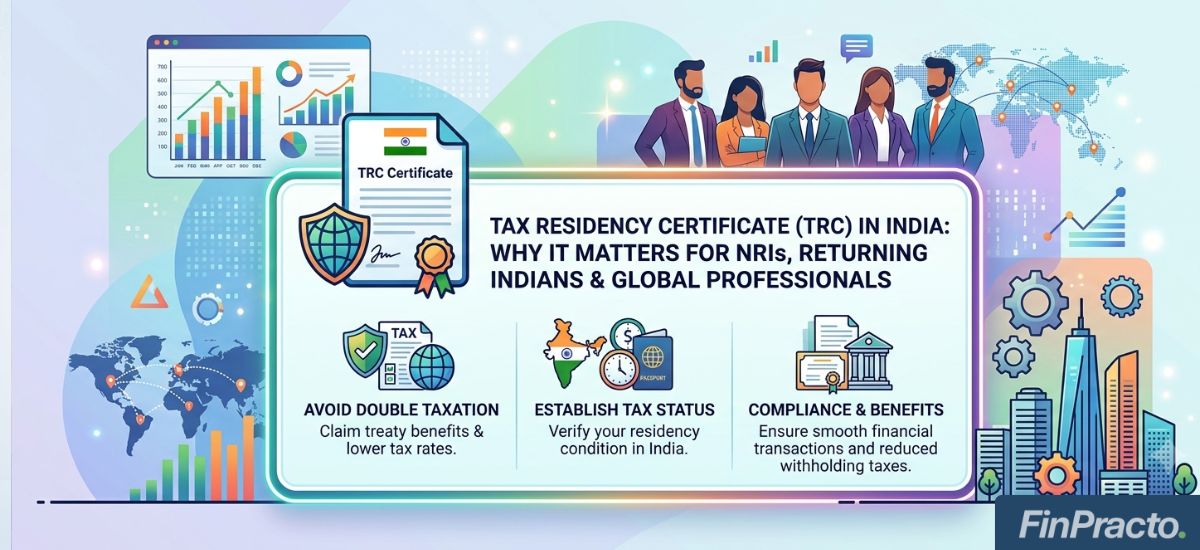
As global mobility increases, it is becoming increasingly common for individuals to earn income in multiple countries. An Indian citizen may be working in the United States, holding investments in India, receiving rental income from the UAE or planning to return to India after several years abroad.
While international opportunities create wealth, they also create tax complexities. One of the most important documents in international taxation is the Tax Residency Certificate (TRC), which plays a crucial role in claiming tax treaty benefits and mitigating the risk of double taxation.
With the introduction of the Income-tax Act, 2025, taxpayers dealing with cross-border income should understand how tax residency documentation fits into the broader framework of international tax compliance.
Understanding Tax Residency in a Global Economy
One of the biggest misconceptions among NRIs and expatriates is that nationality determines tax liability. Taxation is often driven by tax residency, not citizenship.
A person may be:
- An Indian citizen but a tax resident of another country.
- A foreign citizen but a tax resident of India.
- Taxable in more than one jurisdiction due to domestic tax laws.
When multiple countries claim taxing rights over the same income, tax treaties become important. This is where a Tax Residency Certificate serves as a critical piece of evidence.
What is a Tax Residency Certificate (TRC)?
A Tax Residency Certificate is an official certification issued by the tax authorities of a country confirming that an individual or entity is regarded as a tax resident of that country during a particular period.
The certificate acts as documentary proof of residency and is commonly used while claiming benefits under a Double Taxation Avoidance Agreement (DTAA).
In practical terms, a TRC helps establish which country has the primary right to tax a particular stream of income and whether treaty relief may be available.
Why Does a TRC Matter?
A TRC is not merely a compliance document. It can have a direct impact on an individual’s tax liability. Without appropriate residency documentation:
- Income may be taxed twice.
- Treaty benefits may be denied.
- Higher withholding taxes may apply.
- Foreign tax credit claims may become difficult to substantiate.
For individuals earning cross-border income, the financial implications can be significant.
Situations Where a TRC Becomes Relevant
A Tax Residency Certificate may become important in several situations.
Overseas Employment Income
Professionals working abroad often continue to maintain financial ties with India through investments, bank accounts or property ownership. Determining where income should be taxed frequently requires treaty analysis supported by residency documentation.
Rental Income from India
Many NRIs own residential or commercial property in India while residing overseas. A TRC may support claims relating to treaty benefits and foreign tax credits in the country of residence.
Foreign Investments and Capital Gains
Cross-border investors often face tax obligations in more than one jurisdiction. Residency documentation helps establish eligibility for treaty relief and credit mechanisms.
Stock Options, ESOPs and RSUs
Global employees receiving stock-based compensation frequently encounter complex taxation issues involving multiple countries. A TRC often forms part of the supporting documentation required in such cases.
Returning to India
Returning Indians frequently face overlapping tax exposure during transition years. Understanding residency status and obtaining appropriate documentation can help avoid costly mistakes.
TRC and Double Taxation Avoidance Agreements (DTAAs)
India has entered into tax treaties with numerous countries, including United States, United Kingdom, Canada, Australia, Singapore, United Arab Emirates etc. These treaties are designed to prevent the same income from being taxed twice. However, treaty benefits are generally not available merely because a treaty exists.
Tax authorities often require evidence that the taxpayer is genuinely a resident of a treaty country. A TRC serves this purpose.
Key Benefits of Obtaining a TRC
Access to Treaty Benefits
A valid TRC can support claims for concessions available under applicable tax treaties. Depending on the treaty and nature of income, benefits may include reduced tax rates, exemptions, or tax credits.
Reduced Withholding Tax Exposure
Certain jurisdictions may levy tax at higher domestic rates when treaty documentation is not furnished. Providing appropriate residency evidence may help access beneficial treaty rates where available.
Support for Foreign Tax Credit Claims
Individuals paying taxes in one country may be entitled to claim credit in another. A TRC often forms part of the documentation supporting such claims.
Greater Certainty During Assessments
Cross-border transactions increasingly attract scrutiny from tax authorities worldwide. Proper documentation helps demonstrate compliance and reduces uncertainty during assessments.
Common Misunderstandings About Tax Residency
“I am an Indian Citizen; Therefore, I am an Indian Tax Resident”
This is incorrect. Tax residency is determined by specific provisions under tax law and depends on factors such as physical presence and other prescribed conditions.
“I Live in a No-Tax Country, So I have no Tax Obligations”
The absence of personal income tax in a particular country does not automatically eliminate tax implications elsewhere. Income sourced from India may continue to attract tax obligations.
“If Tax was deducted Abroad, I don’t need to Worry”
Tax deducted in one country does not necessarily resolve tax obligations in another. Proper treaty analysis and foreign tax credit planning remain essential.
Practical Considerations for NRIs and Returning Indians
Before claiming treaty benefits, taxpayers should evaluate:
- Their residential status for the relevant year.
- Nature and source of income.
- Applicable DTAA provisions.
- Availability of foreign tax credits.
- Documentation requirements, including TRCs and related disclosures.
Many disputes arise not because treaty relief is unavailable, but because the necessary documentation was not obtained in time.
Key Forms Associated with a Tax Residency Certificate
With the enactment of the Income-tax Act, 2025, the framework relating to Certificates of Residence has been incorporated under the new legislation.
The prescribed forms under the Income-tax Act, 2025 include:
- Form 42 – Application for obtaining a Certificate of Residence.
- Form 43 – Certificate of Residence issued by the prescribed income-tax authority.
Taxpayers claiming treaty benefits may also encounter Form 10F (renumbered as Form 41 under the Income-tax Act, 2025). While Forms 42 and 43 relate to obtaining and issuing a Tax Residency Certificate (TRC), Form 41 is a separate self-declaration containing prescribed information relevant for claiming benefits under a Double Taxation Avoidance Agreement (DTAA).
Individuals earning cross-border income, including NRIs, expatriates, returning Indians, investors and globally mobile professionals, should ensure that appropriate residency and treaty-related documentation is maintained to facilitate smooth access to applicable tax treaty benefits.
How FinPracto Can Assist
International taxation requires more than simply understanding domestic tax laws. It demands an integrated approach that considers treaty provisions, residential status, foreign tax credits, reporting obligations and long-term tax planning.
At FinPracto, we assist NRIs, expatriates, returning Indians, entrepreneurs, investors and globally mobile professionals with:
- Tax residency and treaty analysis
- DTAA advisory and interpretation
- NRI tax planning
- Returning NRI and RNOR planning
- Foreign tax credit advisory
- Cross-border investment structuring
- International income reporting
- Global mobility tax support
Our objective is not merely compliance but helping clients structure their affairs efficiently while remaining fully compliant with applicable regulations.
Frequently Asked Questions (FAQs)
- What is the purpose of a Tax Residency Certificate?
A Tax Residency Certificate serves as proof that an individual or entity is a tax resident of a particular country and is commonly used while claiming treaty benefits under a DTAA.
- Who typically requires a TRC?
NRIs, expatriates, returning Indians, investors, freelancers, consultants, and business owners earning income across multiple countries may require a TRC depending on their circumstances.
- Can a TRC help avoid double taxation?
A TRC is one of the primary documents used to support claims under tax treaties that are designed to prevent the same income from being taxed in two jurisdictions.
- Does Indian citizenship automatically make someone an Indian tax resident?
No. Tax residency is determined under the applicable tax residency rules and not solely by citizenship.
- Why is a TRC important for NRIs?
NRIs often earn income from multiple countries. A TRC may help support treaty benefits, foreign tax credit claims, and withholding tax relief.
- Are treaty benefits available automatically?
No. Tax authorities generally require taxpayers to satisfy prescribed conditions and provide appropriate supporting documentation.
- Can returning Indians benefit from treaty provisions?
Yes. Depending on their residency status, source of income, and treaty provisions, returning Indians may be eligible for various forms of relief.
- Is a TRC relevant for foreign investment income?
Yes. Individuals earning dividends, interest, capital gains, or other investment income across borders may need residency documentation when claiming treaty benefits.
- What should taxpayers review before claiming DTAA relief?
Taxpayers should review their residential status, applicable treaty provisions, documentation requirements, and foreign tax credit implications before making treaty claims.
- When should TRC planning be undertaken?
Ideally before entering into major cross-border transactions, making investments, relocating countries, or claiming treaty benefits, rather than after a tax dispute arises.
- What are Forms 41, 42 and Form 43 under the Income-tax Act, 2025?
Form 42 is the prescribed application for obtaining a Certificate of Residence, while Form 43 is the Certificate of Residence issued by the prescribed income-tax authority. Form 41 is a separate self-declaration that may be required when claiming benefits under a Double Taxation Avoidance Agreement (DTAA). Together, these documents help taxpayers establish tax residency and support treaty benefit claims where applicable.