
India continues to be one of the world’s most attractive investment destinations, driven by a large consumer market, policy reforms, digital transformation and robust economic growth. For foreign investors, however, understanding India’s Foreign Direct Investment (FDI) framework is critical before entering the market.
Whether you are a multinational corporation, startup founder, family office or overseas entrepreneur exploring opportunities in India, understanding the applicable routes, sectoral caps, compliance requirements and emerging investment sectors can help you make informed decisions and avoid regulatory hurdles.
Understanding Foreign Direct Investment (FDI)
Foreign Direct Investment (FDI) refers to an investment made by a person resident outside India in the capital instruments of an Indian company or LLP with the intention of establishing a lasting interest and business presence.
India’s FDI framework is primarily governed by:
- Foreign Exchange Management Act, 1999 (FEMA)
- Foreign Exchange Management (Non-Debt Instruments) Rules, 2019
- Consolidated FDI Policy issued by the Department for Promotion of Industry and Internal Trade (DPIIT)
- RBI regulations and reporting requirements
The Indian government has progressively liberalized FDI norms across various sectors to encourage foreign capital inflows and technology transfer.
Why Foreign Investors are looking at India
Several factors continue to make India an attractive destination for global investors:
Large and Growing Consumer Market
With a population exceeding 1.4 billion and a rapidly expanding middle class, India offers significant demand across industries.
Strong Economic Growth
India remains among the fastest-growing major economies, creating opportunities across manufacturing, infrastructure, technology, healthcare, and financial services.
Government Initiatives
Programs such as Make in India, Digital India, Startup India and Production Linked Incentive (PLI) Schemes have significantly improved the investment ecosystem.
Strategic Global Positioning
As companies diversify supply chains beyond traditional manufacturing hubs, India is increasingly emerging as a preferred destination for long-term investments.
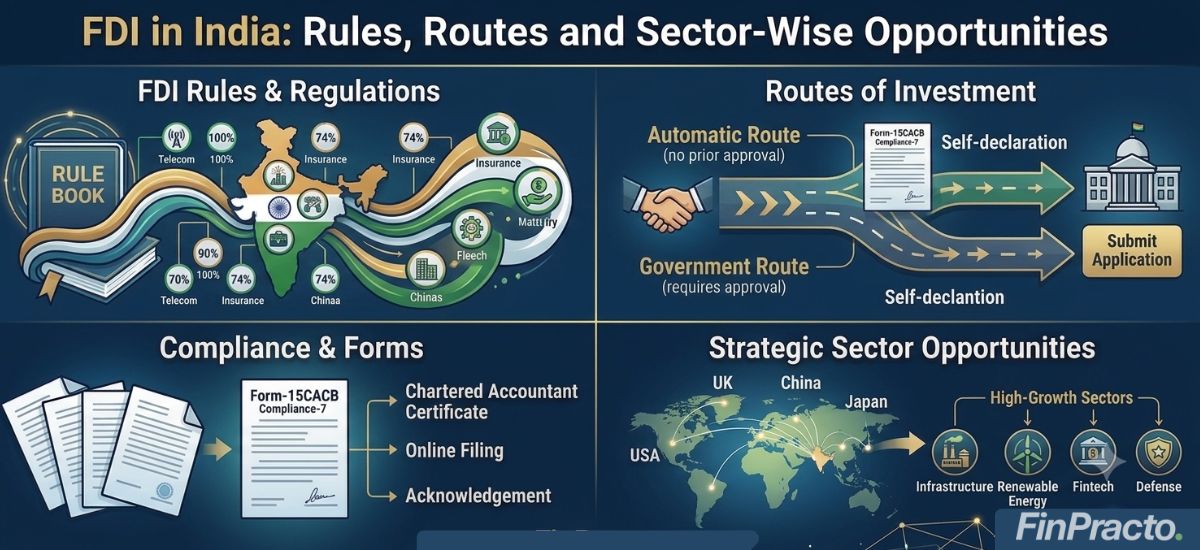
Routes for Foreign Investment in India
FDI can generally be made through two routes:
-
Automatic Route
Under the Automatic Route, foreign investors do not require prior approval from the Government of India.
Investment can be made directly subject to:
- Sectoral caps
- Pricing guidelines
- FEMA regulations
- Applicable reporting requirements
Most sectors today fall under this route, making investments faster and more efficient.
Examples: Manufacturing, Information Technology, Renewable Energy, E-commerce Marketplace Model, Infrastructure Development etc.
- Government Approval Route
Certain sectors require prior approval from the concerned ministry or government authority before investment can be made.
Approval applications are processed through the Foreign Investment Facilitation Portal (FIFP).
Common Sectors Under Approval Route
- Certain defense-related investments beyond specified limits
- Media and broadcasting segments
- Multi-brand retail trading
- Investments from countries sharing a land border with India (subject to specific regulations)
Investors should carefully evaluate whether their proposed transaction falls within approval requirements before proceeding.
Understanding Sectoral Caps
A sectoral cap refers to the maximum percentage of foreign ownership permitted in a particular sector. These limits vary depending on the strategic importance and regulatory sensitivity of the industry.
For example:
| Sector | FDI Limit |
| Manufacturing | 100% |
| Single Brand Retail Trading | 100% |
| Insurance | 100% |
| Telecom Services | 100% |
| Defense Manufacturing | Up to 74% Automatic Route |
| Private Sector Banking | Up to 74% |
| Multi-Brand Retail Trading | 51% |
Sector-specific conditions may apply even where higher foreign ownership is permitted.
Key Compliance Requirements for Foreign Investors
Many foreign investors focus heavily on deal structuring but underestimate post-investment compliance obligations.
Some important requirements include:
Entity Incorporation
Selecting the appropriate structure:
- Private Limited Company
- LLP
- Wholly Owned Subsidiary
- Joint Venture
Valuation Compliance
Issue or transfer of shares must comply with FEMA pricing guidelines and valuation requirements.
RBI Reporting
Various reporting forms may be applicable, including: FC-GPR, FC-TRS, LLP-related filings or Annual Foreign Liabilities and Assets (FLA) Return. Delays can attract penalties under FEMA.
Beneficial Ownership Disclosures
Foreign investors may need to comply with:
- Significant Beneficial Ownership (SBO) regulations
- KYC requirements
- Anti-money laundering norms
Sector-Specific Approvals
Certain industries may require:
- Regulatory registrations
- Industry-specific licenses
- Environmental approvals
- Data protection compliance
High-Growth Sectors Attracting FDI in India
For investors evaluating opportunities, some sectors continue to attract significant foreign investment due to favourable policy support and market demand.
Manufacturing
India’s manufacturing ecosystem has received a major boost through PLI Schemes, Supply chain diversification and Infrastructure development.
Particularly attractive segments include:
- Electronics
- Automotive components
- Semiconductors
- Specialty chemicals
Renewable Energy
India has ambitious renewable energy targets, creating opportunities in Solar power, Wind energy, Battery storage and green hydrogen. The sector benefits from substantial government support and increasing private sector participation.
Technology and Digital Services
India’s technology sector continues to attract global capital across:
- SaaS businesses
- Artificial Intelligence
- FinTech
- Cybersecurity
- Cloud infrastructure
The country’s large talent pool remains a major competitive advantage.
Healthcare and Life Sciences
Growing healthcare demand is driving investments in: Hospitals, Medical devices, Pharmaceuticals, Biotechnology, Telemedicine platforms etc. The sector has become increasingly attractive to global strategic investors and private equity funds.
Logistics and Infrastructure
As India expands its transportation and logistics network, investment opportunities continue to emerge in: Warehousing, Industrial parks, Ports, Airports or Logistics technology. Government spending and private participation are accelerating growth in this sector.
Common Mistakes Foreign Investors Should Avoid
Foreign investors frequently encounter challenges due to avoidable compliance gaps.
Assuming 100% FDI is Allowed Everywhere
Sectoral caps and conditions vary significantly.
Ignoring FEMA Reporting Timelines
Even compliant transactions can face penalties if reporting deadlines are missed.
Overlooking Share Valuation Requirements
Improper pricing structures can trigger regulatory scrutiny.
Choosing the Wrong Investment Vehicle
The tax and compliance implications of a subsidiary, LLP, or joint venture can differ substantially.
Not Evaluating Exit Strategies Early
Investors should assess: Repatriation rules, Transfer restrictions, Tax implications ot Future fundraising plans before making the initial investment.
Strategic Considerations Before Investing
Before entering India, investors should evaluate:
- Sector-specific FDI restrictions
- Tax implications and treaty benefits
- Regulatory approvals and licenses
- Corporate governance requirements
- Exit and repatriation mechanisms
- Ongoing FEMA and RBI compliance obligations
A well-planned investment structure at the outset can significantly reduce future compliance risks and operational challenges.
Conclusion
India’s evolving regulatory framework, growing economy, and expanding investment opportunities continue to position it as a preferred destination for foreign investors worldwide. While the FDI regime has become increasingly liberalized, successful market entry requires a clear understanding of applicable routes, sectoral restrictions, compliance obligations, and industry-specific regulations.
Foreign investors who combine strategic planning with robust regulatory compliance are better positioned to capitalize on India’s long-term growth story while minimizing legal and operational risks.
How FinPracto Can Help
Navigating India’s FDI and FEMA regulations requires careful planning, regulatory expertise and ongoing compliance support. Under the leadership of CA Madhav Batra, FinPracto assists foreign investors, multinational corporations, startups, family offices and overseas entrepreneurs with end-to-end investment and business setup solutions in India, including:
- FDI structuring and entry strategy advisory
- FEMA compliance and regulatory guidance
- Incorporation of Indian subsidiaries, joint ventures and LLPs
- RBI reporting and foreign investment filings
- Assistance with government approvals and sector-specific regulations
- Cross-border transaction and remittance support
- Due diligence and investment readiness reviews
- Corporate, tax and secretarial compliance support
- Ongoing advisory for business expansion and foreign investment management
Whether you are making your first investment in India or expanding an existing presence, our team helps you navigate the regulatory landscape efficiently, minimize compliance risks and establish a strong foundation for long-term growth.