
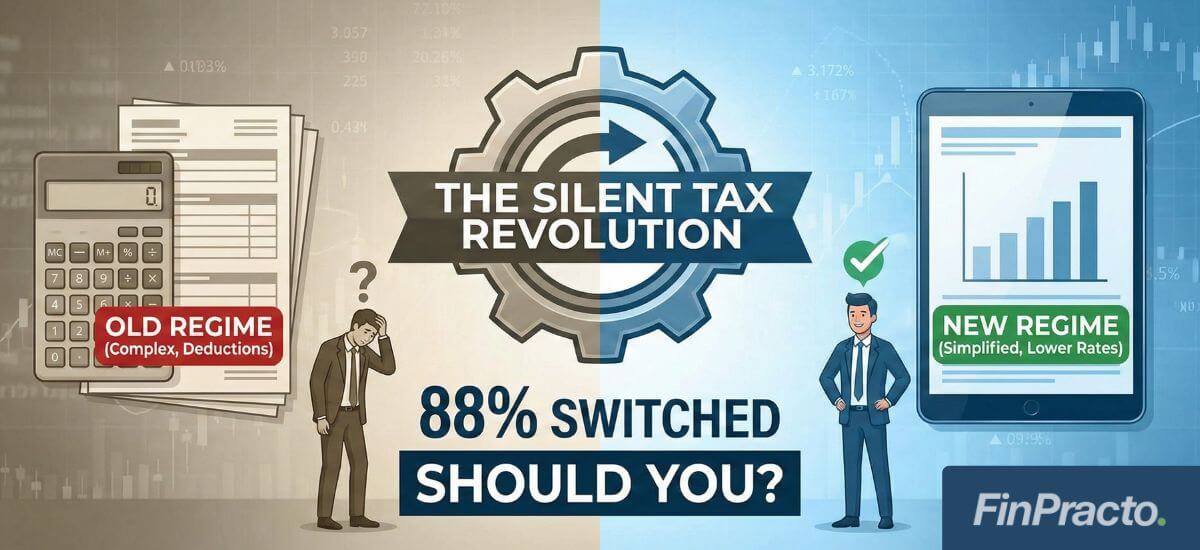
The Quiet Tax Shift That’s Changing How India Files Returns
Over the last few years, something interesting has been happening during tax season.
Fewer people are obsessing over deductions. More people are choosing simplicity.
It didn’t make headlines.
But it quietly changed how India files its returns.
Recent data from the CBDT shows that nearly 88% of individual taxpayers are now choosing the New Tax Regime. That’s not just a small trend. That’s a clear shift in mindset.
For years, tax filing meant collecting proofs, claiming deductions and trying to reduce taxable income as much as possible. Now, a large majority is choosing simplicity over strategy.
So, the real question is:
Why are so many people opting for it? More importantly – should you?
Let’s break it down in simple terms.
From “Save Tax” to “Simplify Tax” – What Changed?
For years, tax planning followed one simple thought:
“How much can I save?”
That usually meant rushing to buy an LIC policy in March, investing in PPF at the last minute, collecting rent receipts, submitting HRA proofs and double-checking every declaration before the deadline. Tax season wasn’t just filing season – it was paperwork season.
Then came the New Tax Regime and it changed the tone of the conversation.
Lower tax rates.
Fewer deductions to track.
Hardly any documentation to scramble for.
Perhaps most importantly – fewer chances of mismatch, errors or follow-up notices.
Today, when tax filings are system-driven, data-matched and increasingly automated, simplicity has started to feel safer than optimisation.
Why Are So Many Taxpayers Choosing the New Regime?
Let’s be honest – people don’t switch tax regimes randomly. They switch because something feels easier, safer or more practical.
Here’s what’s really driving the shift:
1. Compliance Isn’t Casual Anymore
There was a time when deductions were mostly about submitting proofs and moving on.
Today? Everything is tracked.
AIS, Form 26AS, pre-filled returns, automated data matching – the system already knows a lot. Incorrect claims or inflated deductions are much easier to flag.
For many taxpayers, the thought process is simple:
“Why take the risk?”
Choosing the new regime feels cleaner. Fewer claims. Fewer chances of mismatch. Fewer follow-ups. In a system that’s increasingly automated, that peace of mind matters.
2. Not All Deductions Feel Worth It Anymore
There was a time when tax-saving automatically meant investing – sometimes thoughtfully, sometimes simply because the deadline was approaching.
Over the years, however, many taxpayers have begun to look at it more critically. The realisation is subtle but powerful: saving tax on paper does not always mean building wealth in reality.
Money gets locked into long-term products. Investments are made to meet deduction limits, not financial goals. Liquidity is sacrificed for compliance.
The new regime changes that equation. It allows individuals to make investment decisions based on strategy rather than compulsion. It prioritises flexibility over forced planning. For many taxpayers, that sense of control feels far more valuable than maximising deductions.
3. Salary Structures Have Changed
Salary structures today aren’t what they used to be. There are bonuses, ESOPs, performance pay, side gigs, consulting income, multiple employers – income streams are more dynamic than ever. The old regime was built around structured salary components and predictable deductions.
The new regime, on the other hand, fits better with modern income patterns where simplicity often wins over structure.
4. The Government’s Direction Is Clear
While the old regime continues to exist, policy signals increasingly point toward simplification. There’s a clear push toward a more streamlined, trust-based tax environment – one that reduces paperwork and focuses on transparency. Most taxpayers aren’t just reacting to rates – they’re responding to the direction in which the system is evolving.
They’re indeed adapting early.
Here’s the Catch: The New Regime Isn’t Automatically Better
Amid all the numbers and headlines, it’s easy to assume that if 88% have moved, it must be the smarter option for everyone. That’s where things can quietly go wrong. The new regime is simpler – yes. However, simpler doesn’t always mean cheaper.
If you genuinely benefit from certain deductions, the old regime can still work strongly in your favour.
For instance:
- Substantial HRA benefits
- Significant home loan interest claims
- Well-structured salary components
- Deductions and exemptions you consistently and fully utilise
In these situations, moving to the new regime without proper comparison could mean paying more tax – not less. The real issue isn’t choosing the old regime or the new one. It is assuming that what works for the majority will automatically work for you. Tax planning has always been personal. However, in this shift, that truth hasn’t changed.
It’s Not Just a Tax Decision Anymore
There was a time when choosing the “wrong” tax regime simply meant paying a little more tax. It was mostly a financial trade-off. Today, it’s bigger than that.
- A mismatch in regime selection can trigger reporting inconsistencies.
- It can lead to incorrect TDS calculations by employers.
- It can delay refunds.
- It can even result in notices because declarations don’t align with system data.
With the tax ecosystem becoming increasingly data-driven, interconnected and real-time, every choice leaves a digital trail. The system cross-verifies salary, investments, TDS and disclosures automatically. That’s why regime selection is no longer just about maximising savings. It’s about ensuring your filings align smoothly with the system. In today’s environment, the smartest tax decision is the one that balances savings with simplicity and keeps your compliance clean.
Making the Right Choice Requires the Right Guidance
Filing your return is the last step. Making the right choice comes before that.
At FinPracto, the focus isn’t just on submitting forms – it’s on helping you understand which regime works for your income, deductions and long-term plans.
That means:
- Comparing both regimes using your actual numbers
- Looking at compliance impact- not just tax saved
- Reducing the chances of future mismatches, notices or unnecessary revisions
In today’s system, small decisions can have long-term effects. A quick choice made without analysis can cost more than it saves. If most taxpayers have already moved, that doesn’t automatically mean you should – but it does mean you should evaluate carefully.
FinPracto helps you make that evaluation with clarity, not guesswork.
FinPracto – Practical tax decisions, backed by real analysis.