
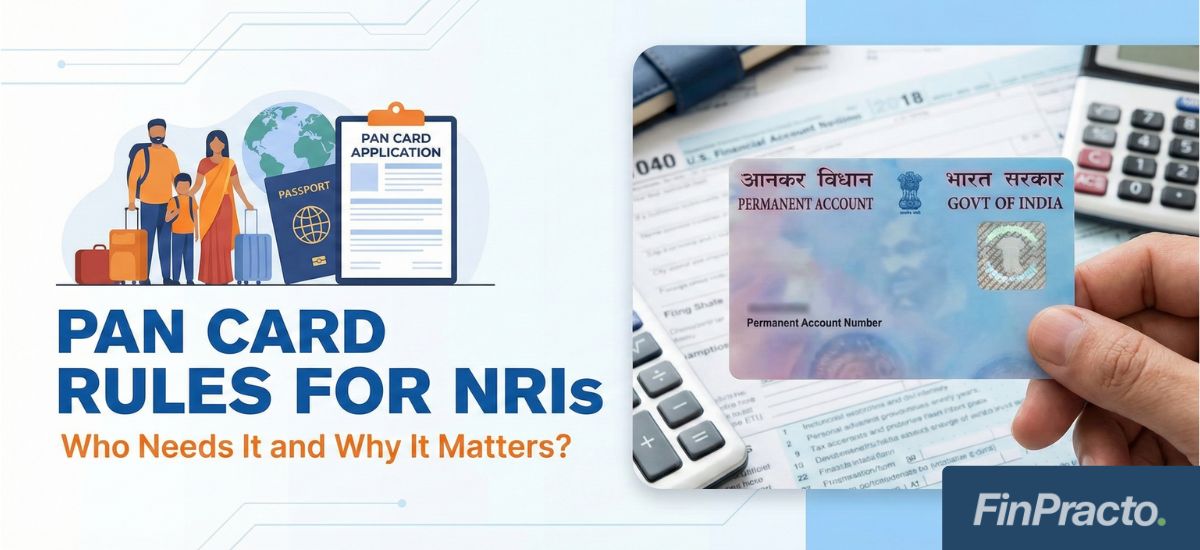
You may live in Dubai, London, New York or Singapore but when it comes to your money in India, one small card still fully runs the show.
Yes, we’re talking about the PAN Card.
If you’re an NRI (Non-Resident Indian) and you own property in India, invest in Indian markets, earn rent or even plan to sell ancestral assets someday – this is for you. The absence of a PAN card doesn’t just cause inconvenience, it can cost you money, time and your peace of mind.
First Things First: Do NRIs Really Need a PAN Card?
Absolutely – If you have any financial footprint in India.
A PAN card is mandatory for NRIs if they:
- Earn any taxable income in India
- Invest in mutual funds, shares or bonds
- Buy or sell property or land in India
- Open or operate NRO / NRE bank accounts
- Claim TDS refunds
- Want to avoid higher tax deductions
No PAN means higher TDS, blocked transactions and endless back-and-forth with banks and tax authorities.
The Hidden Cost of Not Having a PAN
Here’s where most NRIs get caught off guard.
If you earn rental income in India or sell a property and don’t have a PAN, TDS is deducted at the maximum rate sometimes up to 30% or more, even when your actual tax liability is far lower.
While refunds are permitted under the law, not holding a PAN often results in procedural challenges, extended timelines and unnecessary effort that can easily be avoided with timely PAN registration.
A PAN card isn’t just a compliance requirement – it’s a tax-saving tool.
PAN Card for NRIs: What’s Different?
NRIs can apply for a PAN card just like residents, with a few additional documentation steps.
Here’s what’s different:
- Address can be overseas
- Aadhaar is not mandatory
- Passport becomes the primary identity proof
That’s it. No special category, no extra tax burden – just a slightly different process.
Documents You’ll Need to Apply for a NRI Pan Card
To apply for a PAN card as an NRI, you typically need:
- Passport copy (mandatory)
- Overseas address proof (utility bill, bank statement or driving licence)
- Indian address proof (optional, if available)
- Photograph
- Valid email ID & mobile number
That’s all. No need to visit India personally. No need to stand in queues.
How Long Does It Take to Get a Pan Card for NRIs?
- Application to allotment: Usually 7–15 working days
- e-PAN: Often issued faster
- Physical PAN card: Delivered to your overseas address
Delays mostly happen due to incorrect documents or mismatched details, something we can easily help you avoid.
PAN + NRI Investments = A Power Combo
With a PAN card, NRIs can:
- Invest in Indian mutual funds & stocks
- Buy real estate with proper tax planning
- Receive rent after accurate TDS deduction
- File income tax returns and claim refunds
- Repatriate funds smoothly
In short, a PAN unlocks the entire Indian financial ecosystem for NRIs.
Common Myths Busted About NRI Pan Card
“I don’t live in India, so I don’t need a PAN.”
False. Income source matters, not location.
“PAN means I’ll be taxed in India on global income.”
Not true. NRIs are taxed only on India-sourced income.
“The process is complicated.”
Only if you do it without guidance.
Where FinPracto Makes It Effortless?
At FinPracto, we understand one simple truth:
NRIs don’t want paperwork – they want results.
That’s why we:
- Handle end-to-end PAN application for NRIs
- Verify documents before submission (no rejections)
- Coordinate for e-PAN and physical PAN
- Offer tax and investment guidance post-PAN issuance
Whether you’re an NRI investor, landlord or someone planning a future sale of Indian assets – we ensure your PAN works for you.
Final Thought: One Card. Endless Possibilities.
A PAN card may look like a small piece of plastic but for NRIs, it’s the key to compliance, savings and financial freedom in India. If India is part of your financial story, even from thousands of miles away – your PAN card should already be in place.
And if it isn’t?
FinPracto is just one step away from fixing that.