
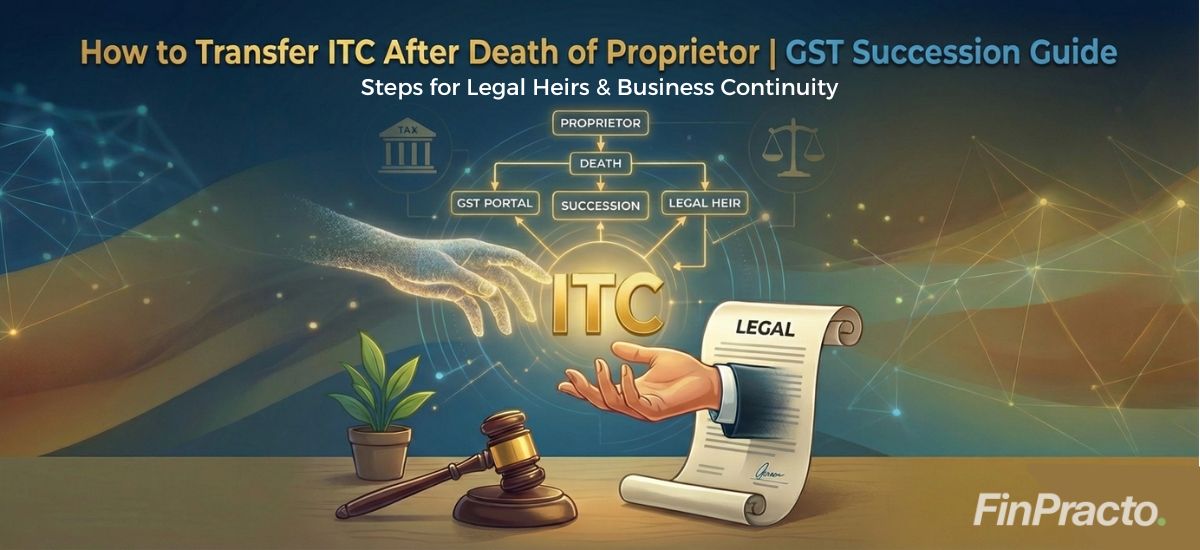
The death of a sole proprietor is not just an emotional loss for the family, it often creates significant tax and compliance challenges for the business left behind. One of the most critical issues faced by legal heirs or successors is the transfer of unutilized Input Tax Credit (ITC) under GST.
Many taxpayers assume that ITC automatically lapses upon death of the proprietor. This is not true. The GST law provides a clear mechanism to transfer the accumulated ITC to the successor, provided the prescribed procedure is followed correctly and on time.
In this blog, FinPracto explains the complete procedure for transfer of ITC in case of death of a sole proprietor, in a simplified and practical manner.
Is Transfer of ITC Allowed on Death of a Sole Proprietor?
Yes. Under GST law, death of a sole proprietor is treated as “transfer of business”. If the business is continued by a legal heir or any other successor, the unutilized ITC lying in the electronic credit ledger can be transferred to the successor.
However, the transfer is not automatic and requires strict procedural compliance.
Who Can Claim the ITC After Death of the Proprietor?
The ITC can be transferred to:
- Legal heirs (spouse, children, family members), or
- Any successor who continues the business
The key condition is that the business must continue, either fully or partially.
Step-by-Step Procedure for Transfer of ITC
Step 1: Obtain New GST Registration by the Successor
The successor / legal heir must:
- Apply for fresh GST registration
- Select the reason as “Death of the Proprietor” while filing GST REG-01
Registration becomes effective from the date of death / succession.
Step 2: File Form GST ITC-02 for Transfer of ITC
This is the most critical step.
- Form GST ITC-02 is used to transfer unutilized ITC
- In case of death, the successor files ITC-02
- The form should be filed before cancellation of the old GST registration
- ITC-02 links:
- Old GSTIN (of deceased proprietor)
- New GSTIN (of successor)
Once accepted, the entire eligible ITC moves electronically to the successor’s credit ledger.
Step 3: Cancellation of Old GST Registration
After ITC transfer:
- Legal heir files GST REG-16
- Reason for cancellation: “Death of Sole Proprietor”
- GSTIN of successor must be mentioned to ensure proper linkage
Important Compliance Points to Note
- ITC transfer is allowed only if business is continued
- ITC-02 must be filed before cancellation
- ITC transfer includes liabilities as well
Successor becomes jointly and severally liable for:
- Pending tax
- Interest
- Penalties of the deceased proprietor
Any mistake in sequencing or filing can result in permanent loss of ITC.
Common Mistakes Businesses Make
- Cancelling GST registration before filing ITC-02
- Not mentioning correct reason (“Death of Proprietor”)
- Delayed registration of successor
- Ignoring past GST liabilities
- Assuming ITC will auto-transfer
These errors often lead to litigation, notices, and financial loss.
How FinPracto Helps You
At FinPracto, we provide end-to-end GST advisory services, including:
- Succession-related GST registration
- ITC transfer via GST ITC-02
- Cancellation of old GSTIN
- Liability reconciliation and compliance review
- Handling GST notices arising post-succession
- Advisory for legal heirs and family-run businesses
Our experts ensure that valuable ITC is preserved, compliances are completed error-free, and successors can continue business without GST complications.
Conclusion
The death of a sole proprietor does not mean the end of GST benefits. Unutilized ITC is an asset, and with the right professional guidance, it can be smoothly transferred to the successor.
However, GST succession cases are procedural and time sensitive. One wrong step can lead to irreversible loss.
If you or your client is facing a GST succession scenario, consult FinPracto today and safeguard your ITC legally and efficiently.