
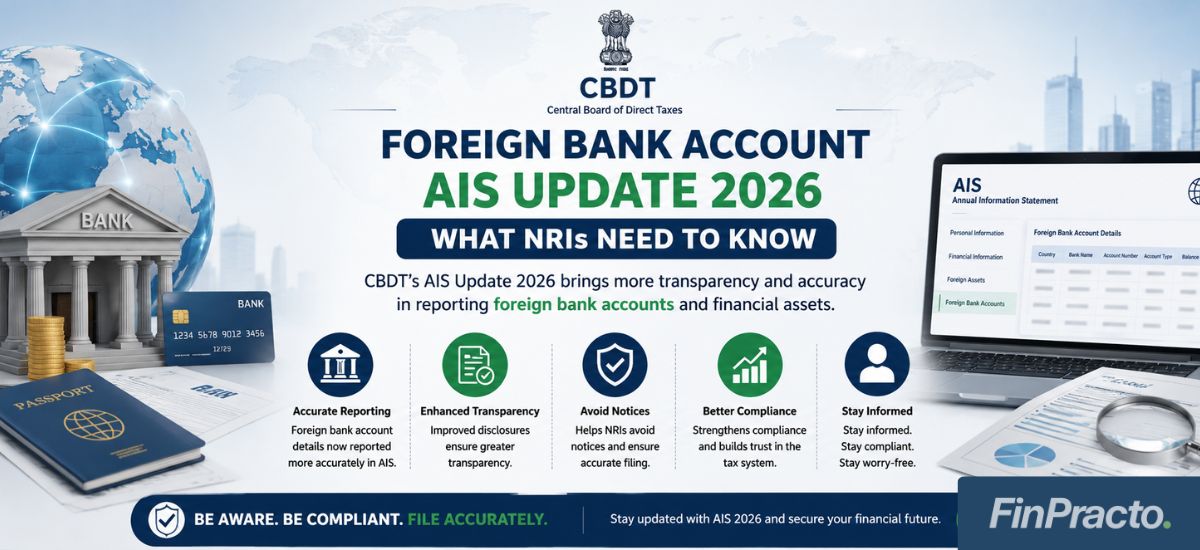
On 8 July 2026 – the Central Board of Direct Taxes issued an order that every NRI, returning Indian and globally mobile professional needs to read carefully.
The CBDT has authorised the Director General of Income Tax (Systems), Delhi to upload foreign financial information received under international tax treaties directly into taxpayers’ Annual Information Statements and Form 26AS.
The information your foreign bank, brokerage, retirement account provider or investment firm has been reporting to your country of residence’s tax authority and which that country has been sharing with India under automatic exchange agreements is about to appear in your Indian tax record.
If you have foreign financial accounts that you have not reported in your Indian ITR – this order means the Income Tax Department is about to know about them too.
What Exactly Has the CBDT Ordered?
The order, issued under Section 239 of the Income Tax Act, 2025, read with Rule 245(2) of the Income Tax Rules, 2026, authorises the DGIT (Systems) to:
Upload information received under the Automatic Exchange of Information (AEOI) framework – covering financial data shared by foreign tax authorities under India’s Double Taxation Avoidance Agreements and other international exchange agreements – into the Annual Information Statement in Form 168 (the new AIS under the IT Act, 2025, replacing Form 26AS).
Separately, upload the same information into Form 26AS for historical periods under the old rules – covering:
- 1 January 2022 to 31 December 2022
- 1 January 2023 to 31 December 2023
- 1 January 2024 to 31 December 2024
All of the above: within 90 days from 8 July 2026 – meaning by approximately 6 October 2026.
For the period 1 January 2025 to 31 December 2025: within 90 days from the end of the month in which that information is received.
The DGIT has also been instructed to prescribe the procedures, formats and technical standards for uploading this information – signalling that this is not a one-time exercise but a permanent, systematic integration of foreign financial data into India’s tax information infrastructure.
What Is AEOI – and why has India had this Data all along?
The Automatic Exchange of Information is a global framework under which countries automatically and systematically share financial information about each other’s residents. India is a member of the Common Reporting Standard (CRS) – the OECD-developed global standard adopted by over 100 countries – under which financial institutions in participating countries report account information of foreign residents to their local tax authority, which then automatically shares it with the account holder’s home country.
India has been receiving this data for years. What has changed with the 8 July 2026 order is that this data – previously sitting with the CBDT’s Foreign Tax and Tax Research Division – will now be surfaced directly into individual taxpayers’ AIS and Form 26AS, making it visible to both the taxpayer and the assessing officer in the same place where Indian income data already appears.
Who does this directly affect?
NRIs who became ROR and did not disclose Foreign Assets
An NRI who returned to India and became Resident and Ordinarily Resident is legally required to disclose all foreign assets in Schedule FA of their Indian ITR. The Black Money (Undisclosed Foreign Income and Assets) and Imposition of Tax Act, 2015 prescribes a penalty of ₹10 lakh per assessment year per asset for non-disclosure – regardless of the asset’s value or whether income was earned.
If you became ROR in AY 2022-23, AY 2023-24 or AY 2024-25 and did not disclose your foreign bank accounts, brokerage accounts, retirement accounts or other financial assets in Schedule FA – the data for those years is about to appear in your AIS. The Income Tax Department will be able to see that your AIS shows foreign financial information that was not reflected in your filed return.
Indian Residents who remitted money abroad under LRS and did not report Investment Income
Indian residents who sent money abroad under the Liberalised Remittance Scheme to invest in foreign stocks, mutual funds, ETFs or real estate and who did not report the resulting dividends, interest or capital gains in their Indian ITR – face the same exposure. The AEOI data will show the account balances, income and transactions.
Returning Indians who never filed Schedule FA for years they were ROR
This is one of the most common compliance gaps we see. Many NRIs returning to India who became ROR in 2022, 2023 or 2024 either did not file an ITR for those years or filed without Schedule FA, not realising they had a disclosure obligation for their US brokerage account, UK ISA, Canadian RRSP or UAE savings.
Indians who received Gifts, Inheritances or Business Payments Offshore
Foreign accounts maintained by Indian residents to receive foreign gifts, inheritance from overseas relatives or business payments – all of which may have been undisclosed – will now surface in the AIS data for 2022, 2023 and 2024.
The FAST-DS 2026 Connection – Why the timing Is Not a Coincidence
The CBDT order dated 8 July 2026 is explicitly timed in the context of the recently announced disclosure scheme under the Black Money Act – the Foreign Asset and Subsidiary Tax Disclosure Scheme (FAST-DS) 2026, introduced through Finance Bill 2026.
FAST-DS 2026 is a one-time, time-limited voluntary disclosure window under which eligible taxpayers can disclose previously undisclosed foreign assets and income – paying a defined tax and penalty and receive immunity from prosecution under the Black Money Act.
FAST-DS is described as a significant one-time opportunity including for persons who are presently non-resident but were resident when the undisclosed foreign income accrued or when the foreign asset was acquired.
What appears in your AIS under AEOI
Under the CRS framework, the following information is reported about foreign financial accounts held by Indian tax residents:
- Account identification: Account number, financial institution name and country
- Account balance: Year-end balance in the account currency
- Income: Interest credited, dividends paid, gross proceeds from sales of financial assets
- Account type: Custodial account (brokerage), depository account (bank savings), other financial account (insurance, annuity)
This means the data appearing in your AIS will show not just that you hold a foreign account – it will show the balance, the income earned and the proceeds from any sales during the year.
What you should do Right Now – Before October 6
The 90-day window from 8 July 2026 is not just the government’s preparation timeline. It is your preparation window.
Step 1: Determine whether you were ROR in AY 2022-23, 2023-24 or 2024-25
If you returned to India and your day count puts you as ROR in any of these years, you had a Schedule FA disclosure obligation. Check your travel records and residential status determination for each year.
Step 2: Review every foreign financial account you held during 2022, 2023 and 2024
Bank accounts, brokerage accounts, retirement accounts (401(k), IRA, RRSP, UK pension), insurance policies with cash value, foreign property held through a financial structure, foreign company shares – all of these are reportable under the CRS and will appear in the AEOI data.
Step 3: Compare against what you filed in those years
For each year you were ROR, check whether your filed ITR includes a complete Schedule FA. If you did not file or filed without Schedule FA or filed Schedule FA but omitted specific accounts – identify the gap.
Step 4: Assess your FAST-DS 2026 eligibility
FAST-DS 2026 covers undisclosed foreign assets where you were resident when the asset was acquired or when the income accrued. If your gap fits this profile, the scheme may provide immunity from prosecution and significantly reduced penalties compared to the standard Black Money Act consequences.
The Consequences of doing Nothing
For NRIs and returning Indians who choose to wait and see – the consequences of the AEOI data appearing in their AIS without a corresponding disclosure in their ITR are severe.
Black Money Act penalties: ₹10 lakh per assessment year per foreign asset – for each of AY 2022-23, 2023-24 and 2024-25 where Schedule FA was missed. Three years, two foreign accounts: ₹60 lakh in penalties before any tax is assessed.
Tax and interest: 30% tax on the fair market value of the undisclosed asset – not just on the income – plus interest from the year of acquisition.
How FinPracto helps you Navigate this
At FinPracto, we have been providing expert NRI Tax Consultancy to NRIs and returning Indians on cross-border compliance, including Schedule FA, Black Money Act exposure, and FAST-DS 2026 planning, well ahead of this CBDT order.
Our services directly relevant to the 8 July 2026 CBDT order include:
- Residential Status Audit – Determining whether you were NRI, RNOR or ROR in AY 2022-23, 2023-24 and 2024-25 from your actual travel records
- Schedule FA Gap Analysis – Reviewing your filed ITRs for each ROR year to identify missing or incomplete foreign asset disclosures
- AEOI Data Assessment – Helping you understand what data is likely to appear in your AIS and cross-referencing it against your compliance history
- FAST-DS 2026 Planning – Once the commencement date is notified, guiding eligible taxpayers through the voluntary disclosure process with correct characterisation and penalty computation
- ITR-U Filing – For years where Indian income was also under-declared, filing Updated Returns to regularise domestic income gaps alongside the FAST-DS process
- Black Money Act Advisory – Assessing the specific consequences applicable to your situation and the optimal resolution route
Final Thought
The 8 July 2026 CBDT order is not a routine administrative update. It is the government closing the information gap that allowed foreign account non-disclosure to continue undetected.
For years, many taxpayers operated on the assumption that what happened in their foreign bank account stayed in their foreign bank account. The AEOI framework has been eroding that assumption for a decade. This order makes it official – the data will now be in your AIS, visible to you and to the Department, cross-referenced against your return.
The question is not whether the Income Tax Department will know. The question is whether you act before they match it – or after.
FAST-DS 2026 is the government’s answer to that question. Use it while it is available.