
The Structural Shift:
The Income Tax Act, 2025 came into force on 1 April 2026, replacing the 64-year-old Income Tax Act, 1961. The stated intent was simplification and for most taxpayers, tax rates, slabs and substantive obligations remain unchanged. However, for transfer pricing, the change is more than cosmetic.
The entire TP framework, previously housed in Sections 92 to 92F of the Income Tax Act, 1961 Act has been reorganised under Chapter 10 of the Income Tax Act, 2025. Section numbers, rule numbers and form numbers have all changed.
The new Act has also introduced structural improvements- particularly around Block TP Assessment, Safe Harbour expansion and a dramatically upgraded disclosure form.
The Single Most Disruptive Change: Form 3CEB Is Gone – Form 48 Is Here
Since 2013, Form 3CEB has been the primary transfer pricing disclosure instrument in India. Every entity with international transactions involving an Associated Enterprise was required to obtain an chartered accountant’s report in Form 3CEB and file it electronically.
Form 48 – which replaces Form 3CEB under the Income Tax Rules, 2026 is a fundamentally different instrument. It is built around six defined Parts and 11 clauses, moving from narrative disclosure to structured, machine-readable data submission.
1. Benchmarking Details Are Now Disclosed in the Form Itself
Form 48 requires benchmarking details, comparable companies, range data and comparability adjustments to be disclosed directly in the form not just maintained in a supporting report.
2. APA-Covered Transactions Must Be Mapped to Form 48 Disclosures
If your entity has an Advance Pricing Agreement in place, Form 48 now requires mandatory mapping of those APA-covered transactions to the relevant disclosures, along with the APA date, acknowledgement number and extent of coverage.
3. Confirmation That a TP Study Has Been Maintained – A New Statutory Obligation
Form 48 requires the taxpayer to explicitly confirm whether a TP study has been maintained. This is a new obligation that did not exist under Form 3CEB.
4. Cross-Verification Risk Is Now Built In
The data submitted in Form 48 can be systematically cross-verified against other tax filings, regulatory submissions and critically shared with foreign tax authorities under exchange of information provisions.
Section and Form Mapping: Income Tax Act, 1961 vs Income Tax Act, 2025
For practitioners and finance teams working across the transition, the table below maps every key TP provision from the old Act to its new reference.
| Provision | IT Act 1961 / IT Rules 1962 | IT Act 2025 / IT Rules 2026 |
| Core TP / Arm’s Length | Section 92 | Section 161 |
| Associated enterprise definition | Section 92A | Section 162 |
| International transaction | Section 92B | Section 163 |
| TP methods / ALP determination | Section 92C / Rule 10B | Section 165 / Rule 79 |
| Documentation obligation | Section 92D / Rule 10D | Section 171 / Rule 84 |
| Accountant’s report | Section 92E / Form 3CEB | Section 172 / Form 48 |
| Safe Harbour | Section 92CB / Form 3CEFA | Section 167 / Form 49 |
| APA application | Section 92CC / Form 3CED | Section 168 / Form 51 |
| APA annual compliance report | Form 3CEF | Form 52 |
| Master File filing | Section 92D / Form 3CEAA | Section 171 / Form 56 |
| CbCR intimation | Form 3CEAB | Form 57 |
| MAP application | Form 34F | Form 55 |
| Penalties (TP) | Section 271AA | Section 442 |
Any TP policy, intercompany agreement, or documentation template that hard-codes old section numbers must be updated before Tax Year 2026-27 filings are submitted.
Block Transfer Pricing Assessment – A Genuine Substantive Change
Under the old framework, the Arm’s Length Price for each international transaction was determined afresh for every assessment year. A company with stable, recurring transactions faced fresh benchmarking and audit exposure annually. Block TP Assessment changes this fundamentally.
The ALP determined in a particular tax year can now be applied to similar transactions in the following two years – a three-year block – at the taxpayer’s discretion. This applies from 1 April 2026.
What this means in practice:
- Multinationals with stable, recurring intercompany service arrangements can secure pricing certainty for three years with a single robust benchmarking exercise.
- The TP study undertaken for Tax Year 2026-27 could anchor pricing through Tax Year 2028-29.
- If the nature of the transaction, functional profile, or market conditions change materially within the block period, the taxpayer must reassess.
- The option must be actively exercised – it does not apply by default.
This aligns India with global best practices in jurisdictions like the UK and Australia. For GCC companies and multinationals with Indian captive units, Block TP Assessment is one of the most operationally valuable changes in the new Act.
Safe Harbour – Expanded Thresholds, Extended Certainty
CBDT Notification No. 21/2025 dated 25 March 2025 updated India’s Safe Harbour Rules, which carry forward under the Income Tax Act, 2025. Two key changes are relevant for Tax Year 2026-27:
Higher transaction threshold: The value limit for Safe Harbour eligibility has been raised from ₹200 crore to ₹300 crore for service transactions, enabling a larger set of Indian subsidiaries and captive units to use the simplified route.
Two-year confirmed applicability: Safe Harbour is confirmed for AY 2025-26 and AY 2026-27, replacing the earlier one-year-at-a-time extensions that created annual planning uncertainty.
| Transaction Type | Minimum Safe Harbour Margin |
| IT / Software development services | 18% |
| IT-enabled services (ITES) | 18% |
| R&D services (software / pharma) | 24% |
| Intra-group loans | Benchmarked rate (LIBOR + prescribed spread) |
| Corporate guarantees | Minimum 1% commission |
| Routine business process outsourcing | 18% |
The Three-Tier Documentation Structure – What Must Be in Each File
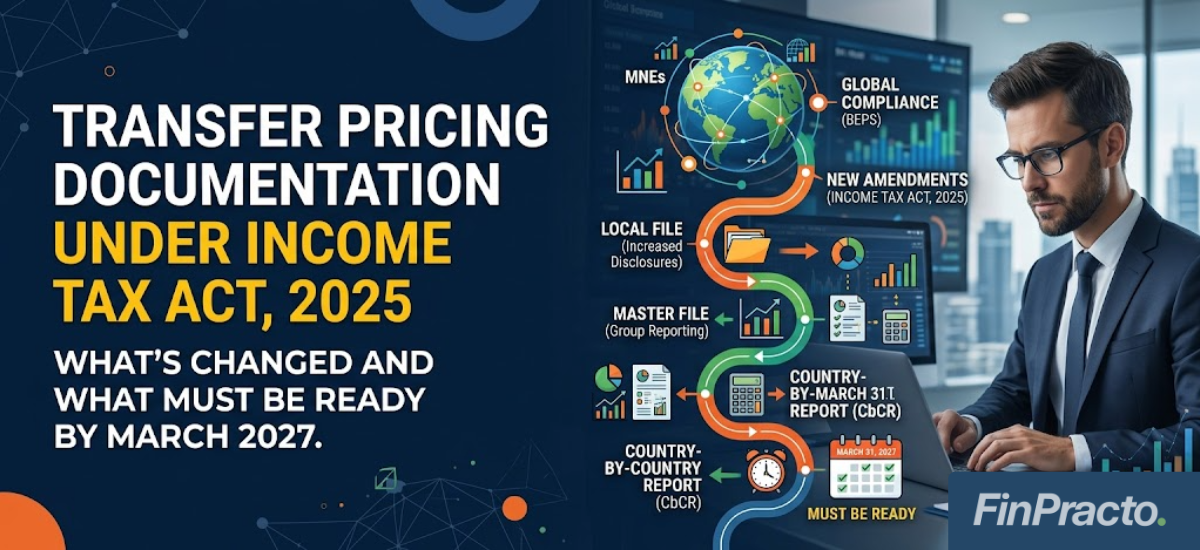
The three-tier framework – Local File, Master File, and Country-by-Country Report – introduced under BEPS Action Plan 13 continues unchanged. The thresholds and filing mechanics under the new Act are as follows.
Tier 1: Local File (TP Study / Rule 10D Documentation)
Who must maintain it: Every entity where the aggregate value of international transactions with Associated Enterprises exceeds ₹1 crore during the tax year.
The Local File must contain:
- Description of the entity’s business, industry and competitive environment
- Functional analysis (FAR) — functions performed, assets employed, risks assumed
- Nature and terms of each international transaction
- TP method selected and reasons for rejecting alternative methods
- Economic analysis: benchmarking search, comparable companies, range calculation
- Any comparability adjustments made
Critical deadline: The Local File must exist by the “specified date” – one month before the return filing due date. For most corporations this means being ready by 31 October. Documentation assembled after return filing is not contemporaneous and will not protect against penalty.
Tier 2: Master File
Who must file it: Any constituent entity of an MNE group where consolidated global revenue exceeds ₹500 crore, or the entity’s international transactions exceed ₹50 crore (₹10 crore for intangible-related transactions).
How it is filed: Electronically in Form 56 (previously Form 3CEAA), without requirement of CA certification.
Tier 3: Country-by-Country Report (CbCR)
Who must file it: The parent entity (or designated surrogate) of an MNE group where consolidated global revenue exceeds ₹6,400 crore (approximately USD 837 million).
CbCR data is shared with foreign tax authorities under India’s exchange of information agreements. Any inconsistency between your CbCR, Form 48 and Local File disclosures will be visible internationally.
The Penalty Framework – Unchanged but More Consequential
The penalty provisions under the Income Tax Act, 2025 retain the same structure as the 1961 Act, now housed in Chapter 21. With Form 48’s cross-verifiable data, the TPO’s ability to identify documentation failures has increased substantially.
| Violation | Penalty |
| Failure to maintain Local File documentation | 2% of aggregate international transaction value |
| Failure to report a transaction or mis-reporting | 2% of aggregate international transaction value |
| Failure to file Master File (Form 56) | ₹5,00,000 flat |
| Failure to file CbCR | Up to ₹50,000 per day (continuing default) |
| Transfer pricing adjustment by the TPO | 100%–300% of tax on the adjustment |
Four Mistakes That Will Be Far More Costly Under the New Regime
1. Filing Form 48 Without Complete Documentation
Form 48 requires an affirmative confirmation that a TP study exists. Filing the form without a complete, contemporaneous study is now a statutory misrepresentation – not merely a documentation gap.
2. Inconsistency Between Form 48, CbCR and Financial Statements
With cross-verification built into the new system, discrepancies that previously went undetected will be flagged automatically. Every number in Form 48 must be reconcilable with audited financials and CbCR filings.
3. Not Updating Intercompany Agreements
Agreements that cite Section 92B, 92D or 92E of the Income Tax Act, 1961 reference repealed provisions from 1 April 2026. While this does not invalidate the agreements, it creates documentation inconsistency that becomes a red flag in an audit.
4. Assuming Block TP Assessment Applies Automatically
Block TP Assessment is an option to be actively exercised, not a default. Entities that assume their AY 2025-26 ALP automatically carries forward for three years without electing and documenting the block will have no protection.
How FinPracto Supports Multinationals Through This Transition
At FinPracto, we work with foreign companies operating in India, India-headquartered multinationals with overseas subsidiaries, and GCC/captive units across sectors – all facing this compliance transition.
Our transfer pricing compliance support for Tax Year 2026-27 includes the following:
- Complete Local File preparation under the Income Tax Act, 2025 framework with contemporaneous benchmarking
- Form 48 preparation and filing, including the new structured 6-part disclosure format
- Master File (Form 56) preparation and electronic filing
- CbCR review and consistency analysis across Form 48 and financial statements
- Block TP Assessment eligibility assessment and documentation
- Safe Harbour analysis and Form 49 filing where applicable
- APA programme advisory and Form 51 application support
- Review and update of intercompany agreements for Income Tax Act, 2025 compliance
- End-to-end International Tax and Transfer Pricing Advisory
The Income Tax Act, 2025 does not make transfer pricing more onerous in principle, but it makes non-compliance more visible, inconsistencies more detectable, and documentation failures more expensive to defend.