
January 2026 may well be remembered as the moment when certainty quietly exited India’s international tax landscape.
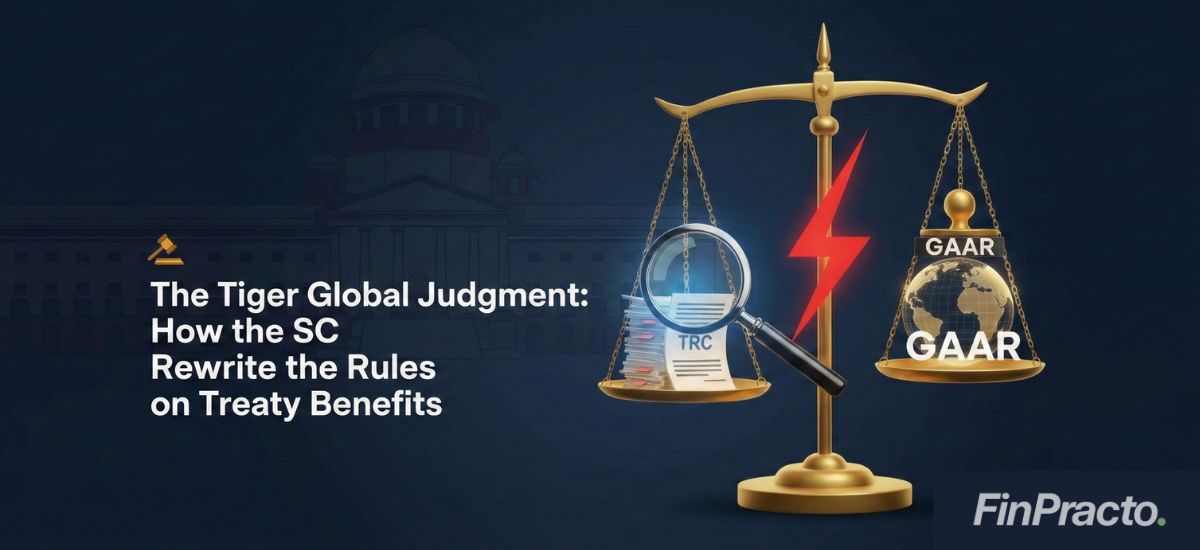
For decades, foreign investors believed that a Tax Residency Certificate (TRC) was the final word – a shield against prolonged scrutiny, a passport to treaty protection, and a symbol of stability in cross-border taxation. That belief has now been decisively shaken.
In a landmark judgment delivered on 15 January 2026, the Supreme Court of India upheld the Revenue’s right to look beyond form, beyond residence certificates, and beyond even grandfathering provisions – to examine whether an arrangement was impermissibly designed to avoid tax.
This is the story of that case.
And why it is far more unsettling than it first appears.
The Investment That Looked Perfectly Ordinary
The facts, at least initially, seemed unremarkable.
Three Mauritius-incorporated companies – part of the Tiger Global investment ecosystem -had invested in Flipkart Singapore, which in turn held operating businesses in India. The investments were made years earlier, long before India amended its tax laws to target indirect transfers.
In 2018, when Walmart acquired Flipkart, these Mauritius entities exited their investment, earning capital gains exceeding USD 2 billion.
They had everything investors are told to have:
- Valid Global Business Licences
- Valid Tax Residency Certificates (TRCs) from Mauritius
- A tax treaty that, on its face, allocated taxing rights to the country of residence
Confident of their position, the investors did what any prudent taxpayer would do.
They approached the Indian tax authorities before the transaction.
Stage One: The First Crack Appears The LDC Shock
Before completing the sale, the taxpayers applied for a Nil withholding certificate under Section 197 of the Income-tax Act.
Their argument was straightforward:
- Capital gains were exempt under the India Mauritius tax treaty
- No tax was payable in India
- Therefore, no tax should be withheld
The response from the tax authorities was swift and alarming.
The Nil certificate was denied.
Instead, withholding tax rates of 6% to 8.47% were imposed.
The reason?
According to the Revenue:
- The Mauritius entities did not take independent decisions
- Control and decision-making lay outside Mauritius
- The structure appeared to be a conduit
For the first time, a chilling message emerged:
A TRC may exist – but it may not be enough.
The investors escalated the matter to the next forum meant precisely for certainty.
Stage Two: The AAR Door Slams Shut
The Authority for Advance Rulings (AAR) is designed to provide clarity before disputes arise. The taxpayers approached it seeking a ruling on whether their capital gains were taxable in India.
What followed was not a ruling but a refusal.
The AAR declined to even answer the question.
Why?
Because, in its view, the transaction was prima facie designed for tax avoidance, triggering the statutory bar on maintainability.
The AAR pointed to:
- Bank accounts controlled by individuals outside Mauritius
- Decision-making authority concentrated in non-Mauritian hands
- The fact that the shares sold were of a Singapore company, not an Indian one
- The absence of direct business operations in India
The conclusion was stark:
This was not a simple sale – it was a preordained arrangement.
The applications were rejected at the threshold.
At this stage, the anxiety was no longer theoretical.
If the AAR could refuse jurisdiction, where did certainty go?
The investors turned to the High Court.
Stage Three: Calm Restored The High Court Intervenes
In August 2024, the Delhi High Court delivered what many saw as a return to sanity.
The Court carefully dismantled the AAR’s reasoning:
- An investment manager is not a parent company
- Oversight does not equal control
- Board decisions were taken collectively
- The entities were not shell companies but legitimate pooling vehicles
- No evidence showed that gains were passed through to another entity
Most importantly, the Court reaffirmed a principle investors had relied upon for years:
A valid TRC creates a presumption of treaty entitlement.
Relying on earlier Supreme Court jurisprudence, the High Court held that:
- Routing investments through Mauritius is not, by itself, abusive
- Indirect transfers deriving value from Indian assets could still qualify for treaty protection
- Grandfathering provisions could not be nullified by administrative suspicion
For a brief moment, it appeared that the storm had passed.
But the Revenue appealed.
Stage Four: The Supreme Court Changes the Conversation
What the Supreme Court did in January 2026 was not merely reverse the High Court.
It reframed the entire legal conversation.
The Court began by clarifying something critical:
- The first question is not treaty protection
- The first question is domestic taxability
Under India’s post-Vodafone law, indirect transfers are deemed taxable if they derive substantial value from Indian assets. That threshold was easily crossed.
Only then, the Court said, does the treaty come into play and only conditionally.
The Court’s most consequential findings:
- A TRC is only an eligibility document, not conclusive proof
- Tax authorities are entitled to examine real control, purpose, and substance
- GAAR overrides treaty benefits where arrangements are impermissible
- Grandfathering is not absolute if the tax benefit arises after the cut-off date
- Even judicial anti-avoidance principles survive alongside GAAR
Perhaps the most unsettling observation was this:
The burden is now on the taxpayer to disprove tax avoidance.
The Supreme Court concluded that:
- The arrangement was impermissible
- The AAR was correct in refusing jurisdiction
- Capital gains were taxable in India
The Delhi High Court judgment was set aside.
So How Is This Different from the Law After Vodafone?
At first glance, one might ask:
Wasn’t Vodafone already neutralised by retrospective amendments?
Yes, but this judgment goes far beyond that.
Vodafone was about:
- Whether India had the right to tax indirect transfers
That battle was settled legislatively.
This judgment is about:
- Whether taxpayers can still rely on procedural and evidentiary shields
And the answer, increasingly, is no.
| Then (Post-Vodafone Law) | Now (2026 Judgment) |
| Indirect transfers taxable | Indirect transfers still taxable |
| Treaty could override if conditions met | Treaty subject to GAAR scrutiny |
| TRC created strong presumption | TRC merely enables enquiry |
| Grandfathering offered comfort | Comfort is conditional |
| AAR was gateway to certainty | AAR can refuse at threshold |
In other words:
Vodafone changed what could be taxed.
This judgment changes how far the Revenue can go.
The Uneasy Takeaway
This decision does not merely apply existing law.
It withdraws the last remaining comforts foreign investors believed they had:
- Residence certificates
- Advance rulings
- Grandfathering clauses
- Predictable treaty outcomes
India’s international tax regime has now moved decisively from certainty-based planning to substance-driven scrutiny.
For investors, advisors, and boards alike, the message is clear:
The question is no longer “Do you have a treaty?”
It is “Can you survive the enquiry?”
If this judgment marks the end of an era, the next challenge is understanding what structures – if any – still stand.